Advertisements
Advertisements
Question
Thinking about the Poem
What are the things the wind does in the first stanza?
Advertisements
Solution
In the first stanza, the wind shutters breaks the shutters of the windows, scatters the papers, throws down the books from the shelf, tears the pages of the books and brings showers of rain.
RELATED QUESTIONS
Match the meanings with the words/expressions in italic, and write the appropriate
meaning next to the sentence.
Wait until I tell his story — it will make your hair stand on end.
Discuss in pairs and answer question below in a short paragraph (30 − 40 words.
How did George and Harris react to this? Did Jerome like their reaction?
Use suitable words or phrases from Column A above to complete the paragraph given below.
A Traffic Jam
During power cuts, when traffic lights go off, there is utter ____ at crossroads. Drivers add
to the confusion by ____ over their right of way, and nearly come to blows. Sometimes
passers-by, seeing a few policemen ____ at regulating traffic, step in to help. This gives
them a feeling of having ____ something.
Thinking about the Text
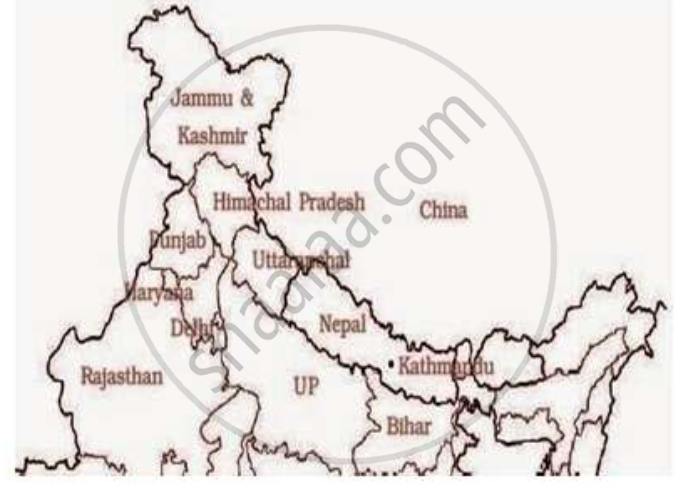
On the following map mark out the route, which the author thought of but did not take, to Delhi.
Thinking about the Poem
What did Saint Peter ask the old lady for? What was the lady’s reaction?
Thinking about the Poem
“Beneath all uniforms…” What uniforms do you think the poet is speaking about?
Answer of these question in a short paragraph (about 30 words).
What shows her concern for the environment?
Before you read "Keeping It From Harold", the teacher will encourage you to answer or discuss the following.
- What are the different weight categories in Boxing?
- Have you ever heard the song whose lyrics go like...."He floats like a butterfly and stings like a bee"? Who does 'he' refer to? He is also known as 'The Greatest' boxer of all times. What was his original name? How many times did he win the World Heavyweight Belt?
- Find out from your friend if he /she watches WWE and who is his/her favourite wrestler. Also find out why he/she likes this wrestler.
- Discuss with your friend as to why these wrestlers have such a large fan following. Has the perception of the people changed over the century with respect to those who fight in the ring?
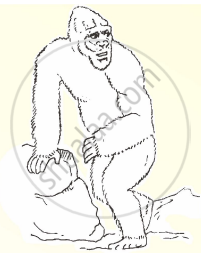
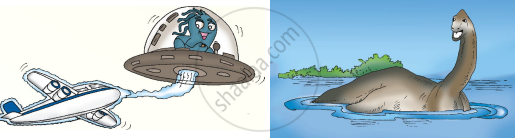
In groups of six, work on one of the mysteries given below by surfing the net and through other sources. Create a power point presentation/a photo essay.
- Yeti, the abominable snowman
- Loch Ness Monster
- UFOs (Unidentified Flying Objects)
- Lost city of Atlantis
- Crop circles
- Nazca lines
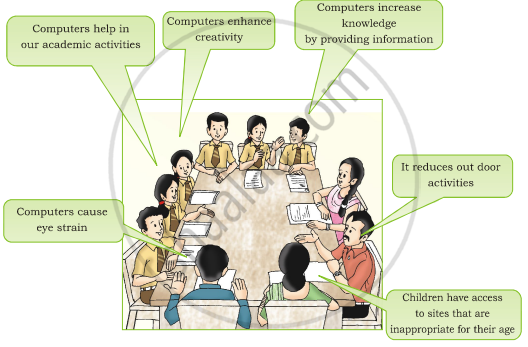
This is a meeting of the school’s Parent-Teacher Association. Some student representatives have also been invited to participate to discuss the role that Information technology/computers play in the growth and development of children.
The black man's face bespoke revenge
As the fire passed from his sight.
For all he saw in his stick of wood
Was a chance to spite the white.
The last man of this forlorn group
Did nought except for gain.
Giving only to those who gave
Was how he played the game.
Their logs held tight in death's still hands
Was proof of human sin.
They didn't die from the cold without
They died from the cold within.
Read the lines given above and answer the question that follow.
What does this say about what prejudice can do to people and the importance of working together?
A free bird leaps on the back
Of the wind and floats downstream
Till the current ends and dips his wing
In the orange suns rays
And dares to claim the sky.
Read the above lines and answer the question that follow.
Explain with reference to the context.
Of the seven hundred villages dotting the map of India, in which the majority of India’s five hundred million live, flourish and die, Kritam was probably the tiniest, indicated on the district survey map by a microscopic dot, the map being meant more for the revenue official out to collect tax than for the guidance of the motorist, who in any case could not hope to reach it since it sprawled far from the highway at the end of a rough track furrowed up by the iron-hooped wheels of bullock carts. But its size did not prevent its giving itself the grandiose name Kritam, which meant in Tamil coronet or crown on the brow of the subcontinent. The village consisted of fewer than thirty houses, only one of them built from brick and cement and painted a brilliant yellow and blue all over with
gorgeous carvings of gods and gargoyles on its balustrade, it was known as the Big House. The other houses, distributed in four streets, were generally of bamboo thatch, straw, mud and other unspecified material. Muni’s was the last house in the fourth street, beyond which stretched the fields. In his prosperous days Muni had owned a flock of sheep and goats and sallied forth every morning driving the flock to the highway a couple of miles away.
Read the extract given below and answer the question that follow.
Where was Muni’s house located?
Name some other creatures that live in anthills.
The following sentence has two blanks. Fill in the blanks with appropriate forms of the word given in brackets.
Asking for_________ is as noble as willingness to________ . (forgive)
Why did the king refuse to give reward to anyone?
How was the wicked farmer punished for his greed?
Look at these sentences.
1. “Too boring,” he said.
2. Cleaned his room, did his chores.
When we speak, we often leave out words that can easily be guessed. We do not do this when we write unless we are trying to write as we speak (as in the story).
So, if we were to write carefully, we would say:
- “Homework is too boring,” he said.
- He cleaned his room and did his chores.
What does the writer say about the friendship between man and dog?
Who is the speaker?
