Advertisements
Advertisements
Question
The types of hybrid orbitals of nitrogen in \[\ce{NO^{+}2}\] , \[\ce{NO^{-}3}\] and \[\ce{NH^{+}4}\] respectively are expected to be ______.
Options
sp, sp3 and sp2
sp, sp2 and sp3
sp2, sp and sp3
sp2, sp3 and sp
Advertisements
Solution
The types of hybrid orbitals of nitrogen in \[\ce{NO^{+}2}\] , \[\ce{NO^{-}3}\] and \[\ce{NH^{+}4}\] respectively are expected to be sp, sp2 and sp3.
Explanation:
The number of orbitals involved in hybridization can be determined by the application of formula:
\[\ce{H = 1/2 [V + M - C + A]}\]
Where H = number of orbitals involved in hybridization
V = valence electrons of central atom
M = number of monovalent atoms linked with central atom
C = charge on the cation
A = charge on the anion
\[\ce{NO^{+}2 : H = 1/2 [5 + 0 - 1 + 0] = 2 or sp}\]
\[\ce{NO^{-}3 : H = 1/2 [5 + 0 - 0 + 1] = 3 or sp^2}\]
\[\ce{NH^{+}4 : H = 1/2 [5 + 4 - 1 + 0] = 4 or sp^3}\]
APPEARS IN
RELATED QUESTIONS
Apart from tetrahedral geometry, another possible geometry for CH4 is square planar with the four H atoms at the corners of the square and the C atom at its centre. Explain why CH4 is not square planar?
What is the total number of sigma and pi bonds in the following molecules?
C2H2
Distinguish between a sigma and a pi bond.
What is the total number of sigma and pi bonds in the following molecules?
C2H4
Predict the shapes of the following molecules on the basis of hybridisation.
\[\ce{BCl3, CH4 , CO2, NH3}\]
Match the species in Column I with the type of hybrid orbitals in Column II.
| Column I | Column II |
| (i) \[\ce{SF4}\] | (a) sp3d2 |
| (ii) \[\ce{IF5}\] | (b) d2sp3 |
| (iii) \[\ce{NO^{+}2}\], | (c) sp3d |
| (iv) \[\ce{NH^{+}4}\], | (d) sp3 |
| (e) sp |
Match the shape of molecules in Column I with the type of hybridisation in Column II.
| Column I | Column II |
| (i) Tetrahedral | (a) sp2 |
| (ii) Trigonal | (b) sp |
| (iii) Linear | (c) sp3 |
Discuss the concept of hybridisation. What are its different types in a carbon atom.
What is the type of hybridisation of carbon atoms marked with star.
\[\begin{array}{cc}
\phantom{.....}\ce{O}\\
\phantom{.....}||\\
\ce{\overset{∗}{C}H2 = CH - \overset{∗}{C} - O - H}
\end{array}\]
What is the type of hybridisation of carbon atoms marked with star.
\[\begin{array}{cc}
\phantom{..........}\ce{O}\\
\phantom{..........}||\\
\ce{CH3 - CH2 - \overset{∗}{C} - H}
\end{array}\]
What is the type of hybridisation of carbon atoms marked with star.
\[\ce{\overset{∗}{C}H3 - CH = CH - CH3}\]
What is the type of hybridisation of carbon atoms marked with star.
\[\ce{CH3 - \overset{∗}{C} ≡ CH}\]
BF3 is a planar and electron-deficient compound. Hybridization and the number of electrons around the central atom, respectively are ______.
In the given reaction,
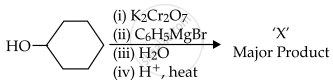
the number of sp2 hybridised carbon (s) in compound 'X' is ______.
In which of the following species S atom assumes sp3 hybrid state?
(I) (SO3)
(II) SO2
(III) H2S
(IV) S8
The hybridisation of carbanion is:
