Advertisements
Advertisements
Question
The susceptibility of magnesium at 300 K is 1.2 × 10⁻⁵. At what temperature will the susceptibility increase to 1.8 × 10⁻⁵?
Advertisements
Solution
Given,
Susceptibility of magnesium at 300 K,
\[\chi_1= 1.2 × 10^{−5}\]
Let T1 be the temperature at which susceptibility of magnesium is 1.2 × 10⁻⁵ and T2 be the temperature at which susceptibility of magnesium is 1.8 × 10⁻⁵.
According to Curie's law,
\[\chi = \frac{C}{T}, \]
where C is Curie's constant.
\[\Rightarrow \frac{\chi_1}{\chi_2} = \frac{T_2}{T_1}\]
\[ \Rightarrow \frac{1 . 2 \times {10}^{- 5}}{1 . 8 \times {10}^{- 5}} = \frac{T_2}{300}\]
\[ \Rightarrow T_2 = \frac{12}{18} \times 300\]
\[ \Rightarrow T_2 = \frac{2}{3} \times 300 = 200 K\]
APPEARS IN
RELATED QUESTIONS
In what way is Gauss's law in magnetism different from that used in electrostatics ? Explain briefly.
State Gauss’s law in electrostatics. A cube which each side ‘a’ is kept is an electric field given by `vecE` = C × l. (as is shown in the figure where C is a positive dimensional constant. Find out
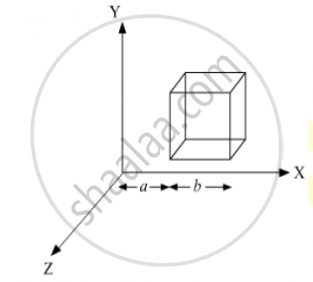
(i) The electric flux through the cube, and
(ii) The net charge inside the cube.
According to Gauss’s law for magnetism ______.
A magnet is suspended horizontally in the earth's magnetic field. When it is displaced and then released it oscillates is a horizontal plane with a period T. If a piece of wood of same moment of inertia (about the axis of rotation) as the magnet is attached to the magnet, what would the new period of oscillation of the system become?
If the magnetic lines of force are shaped like arcs of concentric circles with their centre at point O in a certain section of a magnetic field ______.
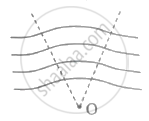
What path do magnetic field lines form?
In electrostatics, what determines the net electric flux through a closed surface?
What is magnetic flux?
What is a Gaussian surface?
Why can a closed surface not enclose a net magnetic “charge” in the way it can enclose electric charge?
Does a bar magnet experience torque on itself due to its own field?
Can a wire element exert force on itself?
For a straight wire, what is the net internal force?
Which example has current loops and magnetic dipole moments even though the atom as a whole is neutral?
