Advertisements
Advertisements
Question
The side of a square is 10 cm. How many times will the new perimeter become if the side of the square is doubled?
Options
2 times
4 times
6 times
8 times
Advertisements
Solution
2 times
Explanation:
Given, side of a square = 10 cm
We know that, perimeter of a square = 4 × Side = 4 × 10 = 40 cm
∴ Perimeter of old square = 40 cm
Now, Side of the square is doubled.
New side = 2 × 10 = 20 cm
Again, perimeter of new square = 4 × Side
= 4 × 20
= 80 cm
∴ New perimeter = 2 × (Old perimeter)
= 2 × 40
= 80 cm
Hence, the new perimeter is 2 times of the old perimeter.
APPEARS IN
RELATED QUESTIONS
The length and the breadth of a rectangle are 36 cm and 28 cm. If its perimeter is equal to the perimeter of a square, find the side of the square.
If P denotes perimeter of a rectangle, l denotes its length and b denotes its breadth, find:
b, if P = 3.2m and l = 100 cm
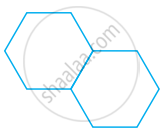
Two regular Hexagons of perimeter 30 cm each are joined as shown in the following figure. The perimeter of the new figure is ______.
Match the shapes (each sides measures 2 cm) in column I with the corresponding perimeters in column II:
| Column I | Column II |
(A)  |
(i) 16 cm |
(B)  |
(ii) 20 cm |
(C)  |
(iii) 24 cm |
(D)  |
(iv) 28 cm |
| (v) 32 cm |
Match the following:
| Shapes | Perimeter |
(A) 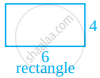 |
(i) 10 |
(B)  |
(ii) 18 |
(C) 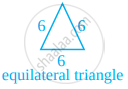 |
(iii) 20 |
(D) 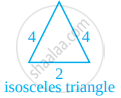 |
(iv) 25 |
Perimeter of the shaded portion in the following figure is ______.
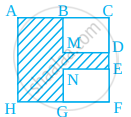
AB + _ + _ + _ + _ + _ + _ + HA
Length of a rectangular field is 6 times its breadth. If the length of the field is 120 cm, find the breadth and perimeter of the field.
What is the length of the wooden strip required to frame a photograph of length and breadth of 32 cm and 21 cm respectively?
What is the perimeter of a closed figure?
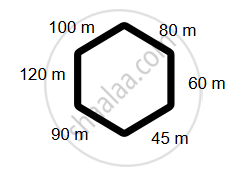
A polygon with sides 100 m, 120 m, 90 m, 45 m, 60 m, and 80 m has a perimeter of: