Advertisements
Advertisements
Question
The sales of a commodity in tones varied from January 2010 to December 2010 as follows:
| In Year 2010 | Sales (in tones) |
| Jan | 280 |
| Feb | 240 |
| Mar | 270 |
| Apr | 300 |
| May | 280 |
| Jun | 290 |
| Jul | 210 |
| Aug | 200 |
| Sep | 230 |
| Oct | 200 |
| Nov | 230 |
| Dec | 210 |
Fit a trend line by the method of semi-average
Advertisements
Solution
Since the number of months is even (12), we can equally divide the given data into two equal parts and obtain the averages of the first six months and last six months
| In Year 2010 |
Sales (in tones) |
Average |
| Jan | 280 | `(280 + 240 + 270 + 300 + 280 + 290)/6` = 276.667 |
| Feb | 240 | |
| Mar | 270 | |
| Apr | 300 | |
| May | 280 | |
| Jun | 290 | |
| Jul | 210 | `(210 + 200 + 230 + 200 + 230 + 210)/6` = 213.33 |
| Aug | 200 | |
| Sep | 230 | |
| Oct | 200 | |
| Nov | 230 | |
| Dec | 210 |
Thus we obtain semi-average I = 276.667 and semi-average II = 213.333
To fit a trend line we plot each value at the mid-point (month) of each half.
i.e we plot 276.667 in the middle of March and April
we plot 213.333 in the middle of September and October.
We join the two points by a straight line.
This is the required line.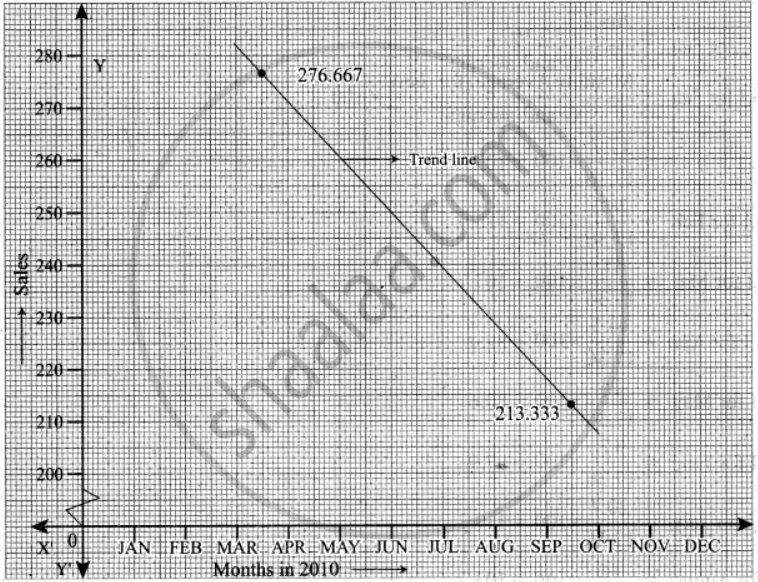
APPEARS IN
RELATED QUESTIONS
State the two normal equations used in fitting a straight line
Compute the average seasonal movement for the following series
| Year | Quarterly Production | |||
| I | II | III | IV | |
| 2002 | 3.5 | 3.8 | 3.7 | 3.5 |
| 2203 | 3.6 | 4.2 | 3. | 4.1 |
| 2004 | 3.4 | 3.9 | 37 | 4.2 |
| 2005 | 4.2 | 4.5 | 3 | 4.4 |
| 2006 | 3.9 | 4.4 | 4.2 | 4.6 |
The following figures relates to the profits of a commercial concern for 8 years
| Year | Profit (₹) |
| 1986 | 15,420 |
| 1987 | 15,470 |
| 1988 | 15,520 |
| 1989 | 21,020 |
| 1990 | 26,500 |
| 1991 | 31,950 |
| 1992 | 35,600 |
| 1993 | 34,900 |
Find the trend of profits by the method of three yearly moving averages
Use the method of monthly averages to find the monthly indices for the following data of production of a commodity for the years 2002, 2003 and 2004
| 2002 | 2003 | 2004 |
| 15 | 20 | 18 |
| 18 | 18 | 25 |
| 17 | 16 | 21 |
| 19 | 13 | 11 |
| 16 | 12 | 14 |
| 20 | 15 | 16 |
| 21 | 22 | 19 |
| 18 | 16 | 20 |
| 17 | 18 | 1 |
| 15 | 20 | 16 |
| 14 | 17 | 18 |
| 18 | 15 | 20 |
Choose the correct alternative:
A time series is a set of data recorded
Choose the correct alternative:
A time series consists of
Choose the correct alternative:
Factors responsible for seasonal variations are
From the following data, calculate the trend values using fourly moving averages.
| Year | 1990 | 1991 | 1992 | 1993 | 1994 | 1995 | 1996 | 1997 | 1998 |
| Sales | 506 | 620 | 1036 | 673 | 588 | 696 | 1116 | 738 | 663 |
Fit a straight line trend by the method of least squares to the following data
| Year | 1980 | 1981 | 1982 | 1983 | 1984 | 1985 | 1986 | 1987 |
| Sales | 50.3 | 52.7 | 49.3 | 57.3 | 56.8 | 60.7 | 62.1 | 58.7 |
The sum of the series 3.6 + 4.7 + 5.8 + ....... upto (n – 2) terms
