Advertisements
Advertisements
Question
Advertisements
Solution
Fill a round bottom flask with a coloured liquid up to the brim. Fit it with a one holed cork and pass a narrow glass tube through it. Mark the level of the liquid in the glass tube as A. Place the flask in a water bath and heat the bath. You will see that the level of liquid of water starts falling to level Band then it rises to level C. In this, AC is the apparent expansion and is due to expansion of the flask due to heating which provides more space for the liquid. Hence the level of liquid drops. As soon as the liquid also starts getting heated up, it expands and the level of liquid rises. BC is the real expansion. So the actual expansion of the water is the sum of AC and AB.

APPEARS IN
RELATED QUESTIONS
What do you understand by thermal expansion of a substance?
A cubical metal solid block is heated. How will its volume change?
At what temperature the pure water has (a) maximum density (b) minimum volume?
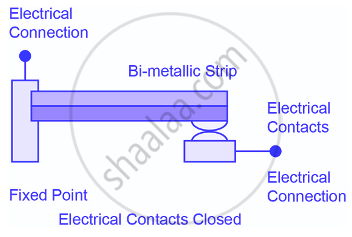
A bimetal strip is shown in the below diagram before heating. Draw a diagram to show how it bends on heating and on cooling.
Thermal expansion is always a nuisance.
What difference do you think heating the solid will make in their molecules?
