Advertisements
Advertisements
प्रश्न
Advertisements
उत्तर
Fill a round bottom flask with a coloured liquid up to the brim. Fit it with a one holed cork and pass a narrow glass tube through it. Mark the level of the liquid in the glass tube as A. Place the flask in a water bath and heat the bath. You will see that the level of liquid of water starts falling to level Band then it rises to level C. In this, AC is the apparent expansion and is due to expansion of the flask due to heating which provides more space for the liquid. Hence the level of liquid drops. As soon as the liquid also starts getting heated up, it expands and the level of liquid rises. BC is the real expansion. So the actual expansion of the water is the sum of AC and AB.

APPEARS IN
संबंधित प्रश्न
Equal volumes of different liquids expand by a different amount when they are heated to the same rise in temperature.
What is matter? What is it composed of?
State three factors on which depend the linear expansion of a metal rod on heating.
What is meant by thermal expansion?
What are the different types of thermal expansions?
Define the following term:
Coefficient of cubical expansion
Give reasons for the following:
In cold countries, water pipes burst in winter.
The diagram shows a sketch graph showing a change in volume of a given mass of ice at -5°C to water at 15°C.
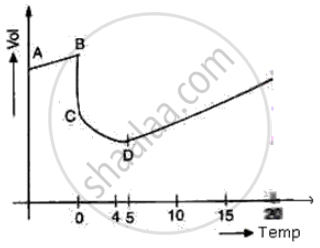
(i) Why does the temperature along BC remain constant?
(ii) When is the volume of water minimum?
(iii) At what temperature does water have maximum density? Explain.
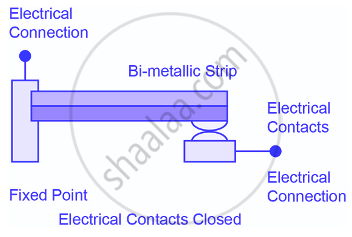
A bimetal strip is shown in the below diagram before heating. Draw a diagram to show how it bends on heating and on cooling.