Advertisements
Advertisements
Question
The radius of a circular wheel is 42 cm. Find the distance travelled by it in :
(i) 1 revolution ;
(ii) 50 revolutions ;
(iii) 200 revolutions ;
Advertisements
Solution
(i)
Radius of wheel, r = 42 cm
Circumference i.e. distance travelled in 1 revolution = 2πr = 2 x 22/7 x 42 = 264 cm
(ii)
Distance travelled in 50 revolutions = 264 x 50 = 13200 cm = 132 m
(iii)
Distance travelled in 200 revolutions = 264 x 200 = 52800 cm = 528 m
Hence (i) 264 cm (ii) 132 m (iii) 528 m
APPEARS IN
RELATED QUESTIONS
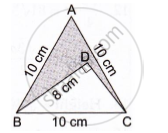
In the given figure, ΔABC is an equilateral triangle the length of whose side is equal to 10 cm, and ΔDBC is right-angled at D and BD = 8 cm. Find the area of the shaded region. [Take `sqrt(3) = 1.732`.]
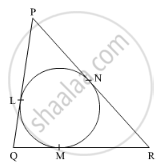
In Figure 5, a circle is inscribed in a triangle PQR with PQ = 10 cm, QR = 8 cm and PR =12 cm. Find the lengths of QM, RN and PL ?
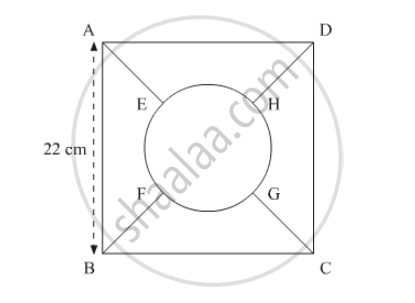
In the following figure, the square ABCD is divided into five equal parts, all having same area. The central part is circular and the lines AE, GC, BF and HD lie along the diagonals AC and BD of the square. If AB = 22 cm, find:
the perimeter of the part ABEF.
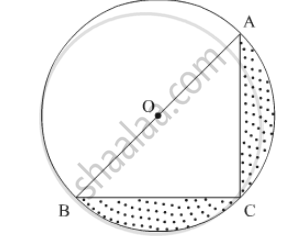
Find the area of the shaded region in the following figure, if AC = 24 cm, BC = 10 cm and O is the centre of the circle. (Use π = 3.14)
What is the ratio of the areas of a circle and an equilateral triangle whose diameter and a side are respectively equal?
Find the ratio of the area of the circle circumscribing a square to the area of the circle inscribed in the square .
If the circumference of a circle increases from 4π to 8π, then its area is
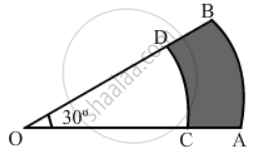
In the given figure, the sectors of two concentric circles of radii 7 cm and 3.5 cm are shown. Find the area of the shaded region.
A table top is semicircular in shape with diameter 2.8 m. Area of this table top is ______.
If the radius of a circle is tripled, the area becomes ______.
