Advertisements
Advertisements
Question
The process for which energy is required is ______.
Options
Passive transport
Diffusion
Osmosis
Active transport
Advertisements
Solution
The process for which energy is required is active transport.
Explanation:
Active travel is against the gradient; thus, it uses energy as such.
APPEARS IN
RELATED QUESTIONS
Active Transport and Diffusion [Significance in plants]
The Biological/technical term for The process of uptake of mineral ions against the concentration gradient using energy from the cell
Name the following:
The wax-like layer on the epidermis of leaves which reduces transpiration.
Fill in the blank with the suitable term given below:
Most water gets evaporated from the plant from its __________.
Fill in the blank with the suitable term given below:
The leaves have more__________ on their lower surface.
How water absorbed by the roots is important for the plants?
Active transport is in a direction ______ to that of diffusion.
Active transport involves ______
Active transport is one in which the ions outside the roots move in by utilising ______.
Three cylinders of potato were carefully dried on blotting paper and weighed. Each piece weighed 3 grams. Each one was placed in the beaker as shown below:
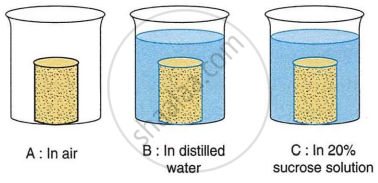
Answer the following questions:
- After 48 hours, which potato cylinder would be the heaviest?
- The movement of which substance is mainly responsible for the weight change in the potato cylinders?
- Name and define the process which is responsible for the movement of the substance mentioned in answer (b).
- Write specific names of the processes which occur in beakers B and C. [kinds of processes defined in answer (c)].
- Would there be any difference in the weight of the potato cylinder in beaker A after 48 hours? Give reason.
