Advertisements
Advertisements
Question
The position of elements A, B, C, D and E in the periodic table are shown below:
|
Group 1 |
Group 2 |
Group 17 |
Group 18 |
|
|
|
|
D |
|
|
B |
C |
|
|
A |
|
|
E |
Which type of ion will be formed by elements A, B, and C.
Advertisements
Solution
Element A will form a positive ion 1+ (cation).
Element B will form a positive ion 2+ (cation).
Element C will form a negative ion 1- (anion).
APPEARS IN
RELATED QUESTIONS
Two elements ‘P’ and ‘Q’ belong to the same period of the modern periodic table and are in Group 1 and Group 2, respectively. Compare their following characteristics in tabular form:-
(a) The number of electrons in their atoms
(b) The sizes of their atoms
(c) Their metallic character
(d) Their tendencies to lose electrons
(e) The formula of their oxides
(f) The formula of their chlorides
List any two properties of the elements belonging to the first group of the modern periodic table.
Use the letters only written in the Periodic Table given below to answer the questions that Follow:
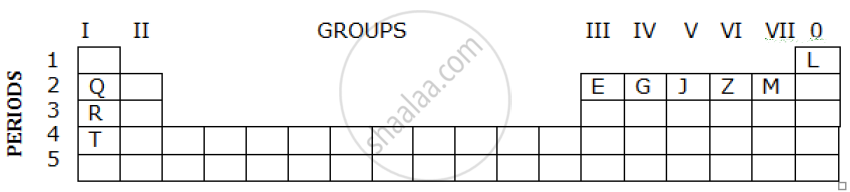
- State the number of valence electrons in atom J.
- Which element shown forms ions with a single negative charge?
- Which metallic element is more reactive than R?
- Which element has its electrons arranged in four shells?
In which part of a group would you separately expect the elements to have the largest atomic size?
The atomic numbers of the elements Na, Mg, K and Ca are 11, 12, 19 and 20 respectively. The element having the largest atomic radius is:
(a) Mg
(b) Na
(c) K
(d) Ca
An element X belong to 4th period and 17th group, state.
Write the formula of the compound formed when it reacts with `(27)/(13) y `
An element 'M' has atomic number 11.
(a) Write its electronic configuration.
(b) State the group to which 'M' belongs.
(c) Is 'M' a metal or a non-metal.
(d) Write the formula of its chloride.
What is modern periodic law?
Choose the correct answer from the choice given:
An element A belonging to Period 3 and Group II will have
Name or state following with reference to the element of the first three periods of the periodic table.
The valency of elements in group 1 [I–A].
