English

The Normal to the Curve X2 = 4y Passing (1, 2) is - Mathematics

Advertisements
Advertisements

Question

The normal to the curve x2 = 4y passing (1, 2) is

(A) x + y = 3

(B) x − y = 3

(C) x + = 1

(D) x − = 1

Advertisements

Solution

The equation of the given curve is x2 = 4y.

Differentiating with respect to x, we have:
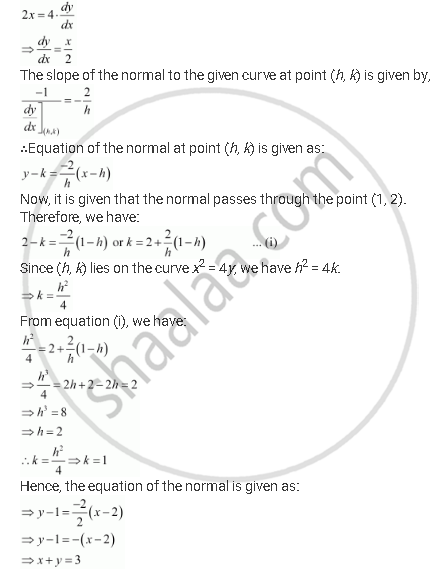
The correct answer is A.

shaalaa.com
  Is there an error in this question or solution?
Chapter 6: Application of Derivatives - Exercise 6.6 [Page 244]

APPEARS IN

NCERT Mathematics Part 1 and 2 [English] Class 12
Chapter 6 Application of Derivatives
Exercise 6.6 | Q 23 | Page 244

Video TutorialsVIEW ALL [2]

RELATED QUESTIONS

Using differentials, find the approximate value of the following up to 3 places of decimal

`(0.009)^(1/3)`


Using differentials, find the approximate value of the following up to 3 places of decimal

`(81.5)^(1/4)`


Show that the function given by `f(x) = (log x)/x` has maximum at x = e.


Find the approximate value of log10 (1016), given that log10e = 0⋅4343.


If y = sin x and x changes from π/2 to 22/14, what is the approximate change in y ?


A circular metal plate expends under heating so that its radius increases by k%. Find the approximate increase in the area of the plate, if the radius of the plate before heating is 10 cm.


The pressure p and the volume v of a gas are connected by the relation pv1.4 = const. Find the percentage error in p corresponding to a decrease of 1/2% in v .


Using differential, find the approximate value of the \[\left( 255 \right)^\frac{1}{4}\] ?


Using differential, find the approximate value of the \[\frac{1}{(2 . 002 )^2}\] ?


Using differential, find the approximate value of the loge 4.04, it being given that log104 = 0.6021 and log10e = 0.4343 ?


Using differential, find the approximate value of the \[\sin\left( \frac{22}{14} \right)\] ?


Using differential, find the approximate value of the \[\left( 80 \right)^\frac{1}{4}\] ?


Using differential, find the approximate value of the  \[\sqrt{0 . 48}\] ?


Using differential, find the approximate value of the \[\left( \frac{17}{81} \right)^\frac{1}{4}\] ?


Using differential, find the approximate value of the \[\sqrt{36 . 6}\] ?


Using differential, find the approximate value of the \[\sqrt{49 . 5}\] ?


If the relative error in measuring the radius of a circular plane is α, find the relative error in measuring its area ?


If the percentage error in the radius of a sphere is α, find the percentage error in its volume ?


The height of a cylinder is equal to the radius. If an error of α % is made in the height, then percentage error in its volume is


While measuring the side of an equilateral triangle an error of k % is made, the percentage error in its area is


The approximate value of (33)1/5 is


The circumference of a circle is measured as 28 cm with an error of 0.01 cm. The percentage error in the area is


Find the approximate values of: `root(3)(28)`


Find the approximate values of : cos(60° 30°), given that 1° = 0.0175°, `sqrt(3) = 1.732`


Find the approximate values of : tan–1(0.999)


Find the approximate value of the function f(x) = `sqrt(x^2 + 3x)` at x = 1.02.


Solve the following : Find the approximate value of cos–1 (0.51), given π = 3.1416, `(2)/sqrt(3)` = 1.1547.


The approximate value of the function f(x) = x3 − 3x + 5 at x = 1.99 is ____________.


Find the approximate value of f(3.02), where f(x) = 3x2 + 5x + 3


The approximate change in volume of a cube of side `x` meters coverd by increasing the side by 3% is


The approximate value of f(x) = x3 + 5x2 – 7x + 9 at x = 1.1 is ______.


Find the approximate value of tan−1 (1.002).
[Given: π = 3.1416]


Share
Notifications

Englishहिंदीमराठी


      Forgot password?
Use app×