Advertisements
Advertisements
Question
Read the extract and complete the activities given below:
|
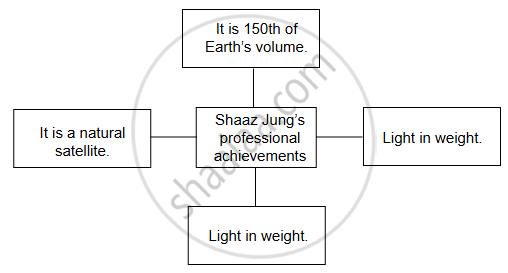
The moon is our inseparable companion in space. It is nearer to the earth than any other heavenly body. It is, in fact, a satellite of the earth. Although it is called a satellite, it is much bigger than many of the satellites of other planets. Therefore, it is sometimes called the earth’s sister planet and sometimes, the earth and the moon are together called a double planet. The moon orbits the earth at a distance varying from 3,53,000 kilometers to 4,05,500 kilometers at a speed of 3,680 kilometers per hour. It takes 27 days, 7 hours, 11 minutes and 5 seconds for one complete revolution. But this duration varies, because the moon, like all the planets, is constantly under the gravitational influences of other planets, the earth and the sun. The moon is also turning on its axis all the time just as the earth is. The length of the time the moon takes to rotate once is about the same as the time it takes to orbit once round the earth. The result of this is that from the earth we always see the same side of the moon. The unseen face is called the far side. It seems to us that the moon rises in the east and sets in the west, just as the sun and the stars do. This rising and setting, however, are due only to the rotation of the earth. It is the earth turning round and round on its axis that causes the appearance of rising and setting. The moon is light in weight and small in volume as compared to the earth. It has only one fiftieth (150th) of the earth’s volume and one eightieth (180th) of its mass. Its diameter is only one-fourth that of the earth, being 3,456 kilometers. Its surface area does not exceed 7.5 percent of the earth’s surface area, that is, it is only about the area of Africa and Europe put together. |
A1. Find out two correct statements from the given options and rewrite them: [2]
- The moon is light in weight and small in volume.
- The moon is a smaller satellite compared to many other satellites of other planets.
- The moon does not turn on its axis at all just as the earth does.
- The moon takes 27 days, 7 hours, 11 minutes and 5 seconds for one complete revolution.
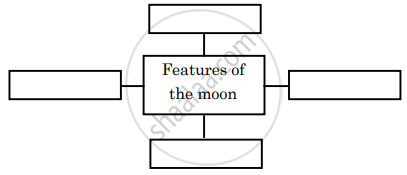
A2. Complete the web diagram given below: [2]
A3. Explain the reason for the variation in the duration for the moon’s single complete revolution from the extract. [2]
A4. Describe ‘Moon’ - as a satellite in your own words. [2]
A5. Language study: [2]
- The moon is nearer to the earth than any other heavenly bodies.
(Identify and rewrite the correct positive degree form of the above sentence from the given options.)
- The moon is nearer to the earth than any other heavenly bodies.
- Very few heavenly bodies are as near to the earth as the moon.
- No other heavenly body is as near to the earth as the moon.
- The moon is the nearest to the earth of all heavenly bodies.
- The unseen face is called the far side.
(Identify and rewrite the correct transformation of the above sentence beginning with, ‘we.....)
- We called the far side as unseen face.
- We called the unseen face as far side.
- We call the unseen face as far side.
- We calls the unseen face as far side.
A6. Vocabulary: [2]
Match the words given in column ‘A’ with their meanings given in column ‘B’-
| ‘A’ | ‘B’ |
| (i) Surface | (a) the amount of space. |
| (ii) Volume | (b) a straight line that goes from one side to the other side of a circle. |
| (iii) Diameter | (c) Curved path taken by a planet as it moves around another planet. |
| (iv) Orbit | (d) Top or flat part of thing. |
Advertisements
Solution
A1.
(a) The moon is light in weight and small in volume.
(d) The moon takes 27 days, 7 hours, 11 minutes and 5 seconds for one complete revolution.
A2.
A3. The moon, like all celestial bodies, is affected by the gravitational pull of the Sun, Earth, and other planets, causing variations in the length of its full rotation. Its velocity is continuously influenced by these gravitational forces, resulting in minor variations in the time it takes to orbit the Earth.
A4. The moon is the Earth’s natural satellite. It is larger than many other planets’ satellites. Even though it revolves around the Earth, its route and revolution are significantly altered by the gravitational attraction of the Earth, the Sun, and other planets.
A5.
- No other heavenly body is as near to the earth as the moon.
- We call the unseen face as far.
A6.
| ‘A’ | ‘B’ |
| (i) Surface | (d) Top or flat part of thing. |
| (ii) Volume | (a) The amount of space. |
| (iii) Diameter | (b) A straight line that goes from one side to the other side of a circle. |
| (iv) Orbit | (c) Curved path taken by a planet as it moves around another planet. |
