Advertisements
Advertisements
Question
The moon is about 384000 km from earth and its path around the earth is nearly circular. Find the length of path described by moon in one complete revolution. (Take π = 3.14)
Advertisements
Solution
Length of path described by moon in one complete revolution = 2πr
= 2 × 3.14 × 384000 ...[∵ Radius = Distance of moon from the earth]
= 2411520 km
APPEARS IN
RELATED QUESTIONS
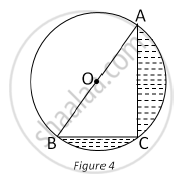
In Fig. 4, O is the centre of a circle such that diameter AB = 13 cm and AC = 12 cm. BC is joined. Find the area of the shaded region. (Take π = 3.14)
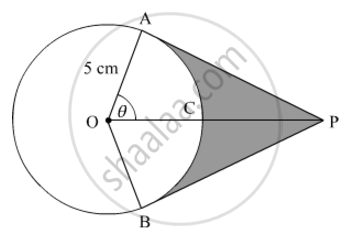
An elastic belt is placed around the rim of a pulley of radius 5 cm. (Fig. 10) From one point C on the belt, the elastic belt is pulled directly away from the centre O of the pulley until it is at P, 10 cm from the point O. Find the length of the belt that is still in contact with the pulley. Also find the shaded area (use π = 3.14 and `sqrt3=1.73)`
The area of circle, inscribed in equilateral triangle is 154 cms2. Find the perimeter of
triangle.
Figure, shows a sector of a circle, centre O, containing an angle θ°. Prove that perimeter of the shaded region is `r(tan θ + sec θ + (πtheta)/180^circ - 1)`.

The difference between the circumference and radius of a circle is 37 cm. The area of the circle is ______.
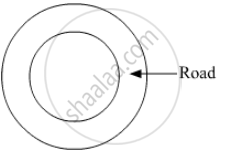
Diameter of the circular garden is 42 m. There is a 3.5 m wide road around the garden. Find the area of the road.
Find the area enclosed between two concentric circles, if their radii are 6 cm and 13 cm respectively.
A conical tent requires 264 m2 of canvas. If the slant height is 12 m, find the vertical height of the cone.
The sum of diameter of two circles is 112 cm and the sum of their areas is 5236 cm2 Find the radii of the two circles.
Using a ruler and compasses only:
(i) Construct a triangle ABC with the following data: AB = 3.5 cm, BC = 6 cm and ∠ ABC = 120°.
(ii) In the same diagram, draw a circle with BC as diameter. Find a point P on the circumference of the circle which is equidistant from AB and BC.
(iii) Measure ∠ BCP.
