Advertisements
Advertisements
Question
The mass of the block P is 5 kg. It is to be moved along an inclined plane AC of length 8 m, which makes an angle of 30° with the horizontal. A force of 50 N is applied on the block to move it through the inclined plane AC, as shown in the diagram.
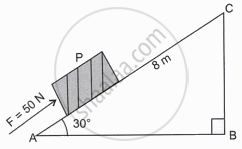
- What is the work done by the force along the inclined plane?
- Find the gain in potential energy of block P if it is directly lifted to C from the ground. (g = 10 ms−2)
- We know that potential energy is gained due to the work done on the body against gravity. Then, in this case, why is the work done on the block and the increase in the potential energy of the block different?
Advertisements
Solution
(a) The force acts along the inclined plane, in the direction of the block’s displacement.
∴ Work done = Force × Distance
= 50 N × 8 m
= 400 J
(b) The vertical height of the plane is h = 8 sin 30° = 4 m.
The gain in potential energy = mgh
= 5 kg × 10 m/s2 × 4 m
= 200 J
(c) The applied force does 400 J of work, but only 200 J is needed to increase the block’s gravitational potential energy. The remaining 200 J is used to overcome friction (and may also contribute to the block’s motion). Thus, the applied work is greater than the increase in potential energy.
