Advertisements
Advertisements
Question
The laws of reflection hold good for
Options
plane mirror only
concave mirror only
convex mirror only
all mirrors irrespective of their shape
Advertisements
Solution
all mirrors irrespective of their shape
Explanation -
The laws of reflection hold good for all mirrors irrespective of their shape.
APPEARS IN
RELATED QUESTIONS
State the laws of reflection.
Describe an activity to show that the incident ray, the reflected ray and the normal at the point of incidence lie in the same plane.
A person 1 m in front of a plane mirror seems to be ______ m away from his image.
Image formed by a plane mirror is ______.
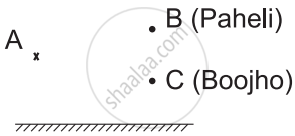
- Find out the position of the image of an object situated at A in the plane mirror.
- Can Paheli at B see this image?
- Can Boojho at C see this image?
- When Paheli moves from B to C, where does the image of A move?
Draw a diagram showing the reflection of a light ray from a plane mirror. Label on it the incident ray, the reflected ray, the normal, the angle of incidence i and the angle of reflection r.
Describe an experiment to verify the laws of reflection of light. Ans. Laws of reflection.
State the two laws of reflection of light.
State the laws of reflection and describe an experiment to verify them.
State the direction of incident ray which after reflection from a spherical mirror retraces its path. Give a reason to your answer.
Reflection of light from rough surface is called ______ reflection
With the help of a diagram, state the laws of reflection
A student does the experiment on tracing the path of a ray of light passing through a rectangular glass slab for different angles of incidence. He can get a correct measure of the angle of incidence and the angle of emergence by following the labelling indicated in figure.
Look at the figure. Can the image of the child in it be obtained on a screen?

We can see things around us only when the light reflected by them reaches our eyes.
A safety vest helps to keep the workers who are working by the roadside safely. This is especially so during the night. Why?
Which of the following is a non-mechanical wave?
