Advertisements
Advertisements
Question
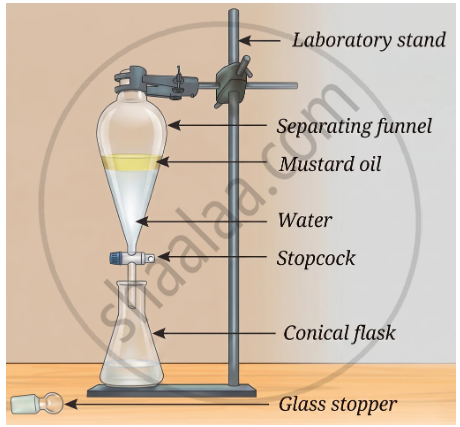
The label on a cooking oil pack says one litre (910 g). If this oil is mixed with water, will it form a separate layer? If so, which substance will be on top? How will you separate the two layers? Also, draw the diagram of the apparatus used.
Advertisements
Solution
Density of the cooking oil
= `"mass"/"volume"`
= `(910 "g")/(1000 "mL")`
= 0.91 g/mL
The density of oil (0.91 g/mL) is lower than that of water (1 g/mL), and oil and water do not mix with each other.
Therefore, oil forms a separate layer when mixed with water. Being lighter, oil stays above the water, which forms the bottom layer.
These two layers can be separated using a separating funnel. The mixture is poured into the funnel and left undisturbed so that distinct layers form. Then, the stopcock is carefully opened to drain the lower water layer. After closing the stopcock, the oil is collected separately.