Advertisements
Advertisements
Question
The inner surface of the reflector of a torch acts as a ______ mirror.
Advertisements
Solution
The inner surface of the reflector of a torch acts as a concave mirror.
Explanation:
The inner surface of the reflector in a torch is curved inward, like a concave mirror. This shape reflects and focuses light from the bulb into a narrow beam, making the light more directed and useful for illumination. A concave mirror converges light rays to a focal point, which is why it’s used in torches to focus the light.
APPEARS IN
RELATED QUESTIONS
Under what condition in an arrangement of two plane mirrors, incident ray and reflected ray will always be parallel to each other, whatever may be angle of incidence. Show the same with the help of diagram.
If an object is placed at a distance of 0.5 m in front of a plane mirror, the distance between the object and the image formed by the mirror will be
A rainbow can be seen in the sky
The outer surface of a flat steel plate acts as a ______ mirror.
What type of mirror is used as a side mirror in a scooter? Why is this type of mirror chosen?
An erect and enlarged image of an object is formed on a screen. Explain how this could be possible.
You are given three mirrors of different types. How will you identify each one of them?
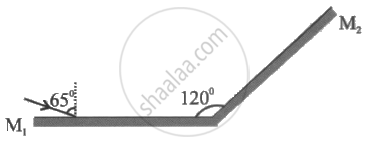
Two plane mirror M1 & M2 are placed at an angle of 120° shown in figure. A light ray is incident on M1 at an angle of 60°; after reflection from M1 the ray strikes M2. The angle which the final reflected ray (after reflection from M2) is making with the plane of mirror M2 is ______.
A plane mirror is moving with velocity `4hati + 5hatj + 8hatk`. A point object in front of the mirror moves with a velocity of `3hati + 4hatj + 5hatk`. Here `hatk` is along the normal to the plane mirror and facing toward the object. The velocity of the image is ______.
If two plane mirrors are kept at 60° to each other, then the number of images formed by them is ______.
