Advertisements
Advertisements
Question
The gravitational potential energy stored in a box of weight 150 kgf is 1.5 × 10⁴ J. Find the height of the box. Take 1 kgf = 10 N.
Advertisements
Solution
Gravitational potential energy (U) = 1.5 × 10⁴ J
Force = weight = 150 kgf = 1500 N ...[1 kgf = 10 N]
Height (h) = ?
U = mg × h
∴ 1.5 × 10⁴ J = 1500 × h
∴ `(1.5 × 10^4 " J")/(1500)` = h
∴ h = 10 m
APPEARS IN
RELATED QUESTIONS
The potential energy of a freely falling object decreases progressively. Does this violate the law of conservation of energy? Why?
A body of mass m is moved from ground to a height h. If force of gravity on mass of 1 kg is g newton, find the work done in lifting the body.
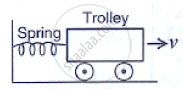
A spring is kept compressed by a small trolley of mass 0.5 kg lying on a smooth horizontal surface as shown in the adjacent fig. When the trolley is released, it is found to move at a speed v = 2 m s-1. What potential energy did the spring possess when compressed?
A ball of mass m is thrown vertically up with an initial velocity so as to reach a height h. The correct statement is:
Two bodies A and B of equal masses are kept at heights of h and 2h respectively. What will be the ratio of their potential energies?
Is potential energy a vector or a scalar quantity?
State whether the following statement is true or false :
The potential energy of a body of mass 1 kg kept at a height of 1 m is 1 J.
To what height should a box of mass 150 kg be lifted, so that its potential energy may become 7350 joules? (g = 9.8 m/s2)
A man is instructed to carry a package from the base camp at B to summit A of a hill at a height of 1200 metres. The man weighs 800 N and the package weighs 200 N. If g = 10 m/s2,
- how much work does man do against gravity?
- what is the potential energy of the package at A if its is assumed to be zero at B?
A car is accelerated on a levelled road and acquires a velocity 4 times of its initial velocity. During this process, the potential energy of the car :
