Advertisements
Advertisements
Question
The graph illustrates the correlation between the number of protons (x-axis) and the number of neutrons (y-axis) for element C in the periodic table. The element is denoted by letters rather than their conventional symbols. When element C, depicted in the graph, undergoes radioactive decay, it releases radioactive rays.
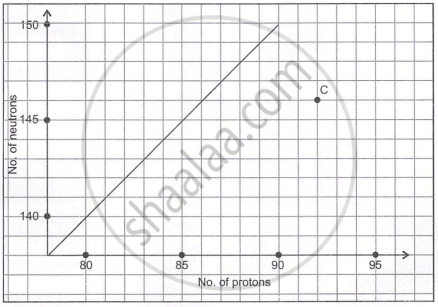
(a) Write the chemical symbol along with the mass number and atomic number for the element denoted as 'C'.
(b) Plot on the graph,
- The daughter element after the emission of beta radiation by the element 'C'.
- The daughter element, as indicated in the previous answer, if it undergoes alpha decay.
Advertisements
Solution
(a) From the graph, element C has
Number of protons (Z) = 92
Number of neutrons (N) = 146
Mass number (A) = Z + N
= 92 + 146
= 238
The element with atomic number 92 is uranium.
\[ {}^{238}_{\phantom{1}92}\mathrm{U} \]
(b)
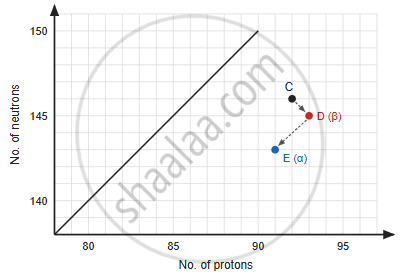
(i) On emitting a beta particle, one neutron changes into a proton. So the number of protons increases by 1 and the number of neutrons decreases by 1.
\[ {}^{238}_{\phantom{1}92}\mathrm{U} \longrightarrow {}^{238}_{\phantom{1}93}\mathrm{Np} + {}^{\phantom{-}0}_{-1}e \]
Daughter element D: protons = 93, neutrons = 145.
It is plotted at the point (93, 145).
(ii) On emitting an alpha particle, 2 protons and 2 neutrons are lost.
\[ {}^{238}_{\phantom{1}93}\mathrm{Np} \longrightarrow {}^{234}_{\phantom{1}91}\mathrm{Pa} + {}^{4}_{2}\mathrm{He} \]
Daughter element E: protons = 91, neutrons = 143.
It is plotted at the point (91, 143).
