Advertisements
Advertisements
Question
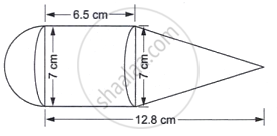
The given figure represents a solid consisting of a cylinder surmounted by a cone at one end and a hemisphere at the other. Find the volume of the solid.
Advertisements
Solution
Given:
Cylinder diameter = 7 cm ⇒ radius r = 3.5 cm.
Cylinder length = 6.5 cm.
Total length from the cylinder’s left face to the cone tip = 12.8 cm, so cone height = 12.8 – 6.5 = 6.3 cm.
A hemisphere of radius 3.5 cm is attached to the other end.
Step-wise calculation:
1. Volume of the cylinder Vcyl = πr2h
= π(3.5)2(6.5)
= π × 12.25 × 6.5
= `(637/8)π cm^3`
2. Volume of the cone `V_"cone" = (1/3)πr^2h`
= `(1/3)π(3.5)^2(6.3)`
= `(3087/120)π cm^3`
3. Volume of the hemisphere `V_"hemi" = (2/3)πr^3`
= `(2/3)π(3.5)^3`
= `(343/12) πcm^3`
4. Total volume Vtotal = Vcyl + Vcone + Vhemi
= `(637/8 + 3087/120 + 343/12) π`
= `(2009/15) πcm^3`
Numeric approximation (using π ≈ 3.14159265):
Vtotal ≈ 133.933333... × π ≈ 420.8 cm3.
The volume of the solid is `(2009/15)` π cm3 ≈ 420.8 cm3.
