Advertisements
Advertisements
Question
The edges of three solid cubes are 6 cm, 8 cm, and 10 cm. These cubes are melted and recast into a single cube. Find the edge of the resulting cube.
Advertisements
Solution
Edge of first solid cube = 6 cm
Volume = (6)3 = 216 cm3
Edge of second cube = 8 cm
Volume = (8)3 = 512 cm3
Edge of third cube = 10 cm
Volume = (10)3 = 1000 cm3
Sum of volumes of three cubes = 216 + 512 + 1000= 1728 cm3
Let a be the edge of so formed cube volume = a3
a3 = 1728 = (12)3
a = 12 cm
APPEARS IN
RELATED QUESTIONS
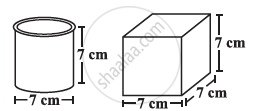
Describe how the two figures at the right are alike and how they are different. Which box has larger lateral surface area?
If each edge of a cube is doubled, how many times will its volume increase?
What will happen to the volume of a cube, if its edge is trebled?
Suppose that there are two cubes, having edges 2 cm and 4 cm, respectively. Find the volumes V1and V2 of the cubes and compare them.
Fill in the blank in the following so as to make the statement true:
The volume of a cube of side 8 cm is ........
Find the volume of a cube whose surface area is 96 cm2.
Four identical cubes are joined end to end to form a cuboid. If the total surface area of the resulting cuboid as 648 m2; find the length of the edge of each cube. Also, find the ratio between the surface area of the resulting cuboid and the surface area of a cube.
Three cubes of sides x cm, 8cm and 10cm respectively are melted and formed into a single cube of edge 12cm, Find 'x'.
A cubical container of side 6.5 m is to be painted on the entire outer surface. Find the area to be painted and the total cost of painting it at the rate of ₹ 24 per m2
A cube of side 4 cm is cut into 1 cm cubes. What is the ratio of the surface areas of the original cubes and cut-out cubes?
