Advertisements
Advertisements
प्रश्न
The edges of three solid cubes are 6 cm, 8 cm, and 10 cm. These cubes are melted and recast into a single cube. Find the edge of the resulting cube.
Advertisements
उत्तर
Edge of first solid cube = 6 cm
Volume = (6)3 = 216 cm3
Edge of second cube = 8 cm
Volume = (8)3 = 512 cm3
Edge of third cube = 10 cm
Volume = (10)3 = 1000 cm3
Sum of volumes of three cubes = 216 + 512 + 1000= 1728 cm3
Let a be the edge of so formed cube volume = a3
a3 = 1728 = (12)3
a = 12 cm
APPEARS IN
संबंधित प्रश्न
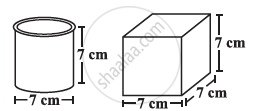
Describe how the two figures at the right are alike and how they are different. Which box has larger lateral surface area?
Fill in the blank in the following so as to make the statement true:
The volume of a wooden cuboid of length 10 cm and breadth 8 cm is 4000 cm3. The height of the cuboid is ........ cm.
Fill in the blank in the following so as to make the statement true:
1 cu. km = ........ cu. m
Find the surface area of a cube whose edge is 3 cm.
Find the volume of a cube whose surface area is 96 cm2.
Three equal cubes are placed adjacently in a row. Find the ratio of total surface area of the new cuboid to that of the sum of the surface areas of the three cubes.
Four identical cubes are joined end to end to form a cuboid. If the total surface area of the resulting cuboid as 648 m2; find the length of the edge of each cube. Also, find the ratio between the surface area of the resulting cuboid and the surface area of a cube.
Three equal cubes are placed adjacently in a row. Find the ratio of the total surface area of the resulting cuboid to that of the sum of the total surface areas of the three cubes.
Find the T.S.A and L.S.A of the cube whose side is 7.5 cm
If the lateral surface area of a cube is 600 cm2, then the total surface area is
