Advertisements
Advertisements
Question
The diagrams given below show the cross-section of two kinds of blood vessels:
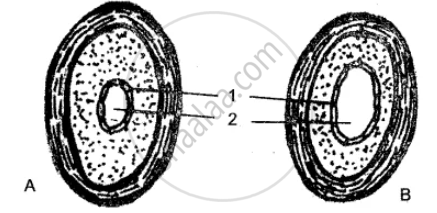
(i) Identify the blood vessels A and B. In each case give a reason to support your answer.
(ii) Name the parts numbered 1 and 2.
(iii) When are the sounds “LUBB” and “DUB” produced during a heartbeat?
(iv) Name the blood vessel that
(a) begins and ends in capillaries.
(b) supplies blood to the walls of the heart.
Advertisements
Solution
(i)
A—Artery
B—Vein, because in A lumen is narrow, in B lumen is wide.
(ii) 1 —> Endothelium, 2 —> Lumen.
(iii) Lubb is produced when the ventricles contract and atrioventricular valves get closed at the beginning of ventricular systole.
Dub is produced by the closure of semilunar valves at the beginning of ventricular diastole.
(iv) (a) Portal system
(b) Coronary arteries
APPEARS IN
RELATED QUESTIONS
Differentiate between arteries and veins.
Write in brief about the following:
Blood groups
The following simplified diagram refers to the outline plan of the circulation of blood in a mammal. Study the diagram and write the number and name of the blood vessel in each case as mentioned ahead.

Which vessel would contain the highest concentration of amino acids and glucose soon after a meal?
Write three types of blood vessels. Give one important feature of each.
Name the blood vessels entering the heart and leaving the heart.
Name the Following
The blood vessel that begins and ends in capillaries.
Multiple Choice Questions
Arteries are:
Long answer question:
How blood is kept moving in the large veins of the legs?
Identify the CORRECT statement.
The absorption of nutrients and exchange of respiratory gases between blood and tissues takes place in –
