Advertisements
Advertisements
Question
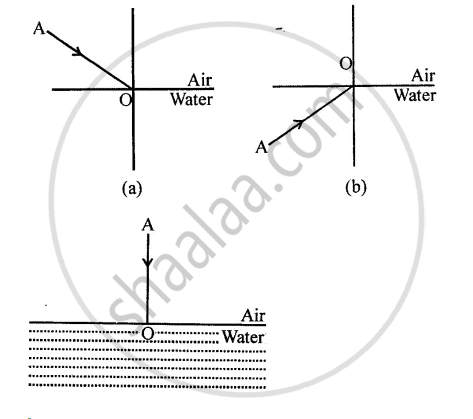
The diagram given below in fig shows a ray of light AO falling on a surface separating two media. Draw the refracted ray in each, case.
Advertisements
Solution
Refracted ray 0 C is shown in each case.
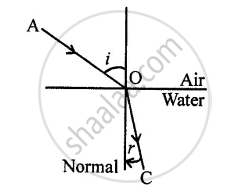
Towards the normal or ∠r < ∠i
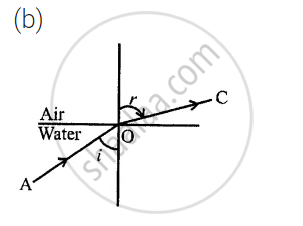
Away from the normal or ∠r > ∠i
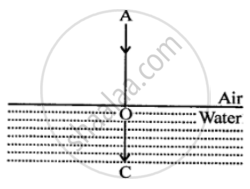
Refracted ray goes undeviated
or
∠i = 0
∠r = 0
APPEARS IN
RELATED QUESTIONS
Describe with a suitable diagram, how a convex mirror diverges a parallel beam of light rays. Mark clearly the pole, focus and centre of curvature of convex mirror in this diagram.
Which mirror has a wider field of view?
What kind of mirrors are used in big shopping centres to watch the activities of the customers?
- Draw a labelled ray diagram to show the formation of image in a convex mirror when the object is at infinity. Mark clearly the pole and focus of the mirror in the diagram.
- State three characteristics of the image formed in this case.
- Draw diagram to show how a convex mirror can be used to give a large field of view.
Draw diagram to show how a convex mirror can be used to give a large field of view.
The diagrams show the appearance of a fork when placed in front of and close to two mirrors A and B, turn by turn.
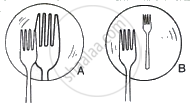
- Which mirror is convex?
- Which mirror is concave?
Give reasons for your choice.
State two uses of a convex mirror.
A boy is standing at a distance of 3m in front of a plane mirror. The distance between the boy and his image is ______m.
The image formed by a convex mirror is always ______.
Higher-Order Thinking Skills:
A convex mirror is in water. What should be the change in its focal length?
