Advertisements
Advertisements
Question
The diagram given alongside represents the human heart in one phase of its activity. Study the same and then answer the question that follow:
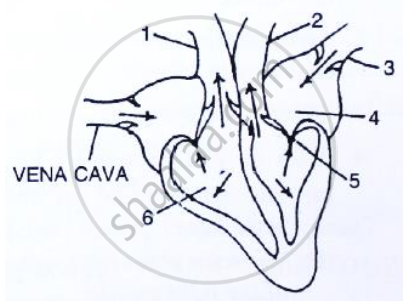
Name the phase.
Advertisements
Solution
Atrial Diastole and Ventricular Systole
RELATED QUESTIONS
The human body has an organ A which acts as a double pump. The oxygenated blood coming from the lungs through blood vessel B enters the upper left chamber C of the double pump. When chamber C contracts, then blood goes into the lower left chamber D. The contraction of chamber D forces the blood to go into a blood vessel E which supplies oxygenated blood to all the organs of the body (except the lungs). The deoxygenated blood coming out of the body organs is taken by a blood vessel F to the right upper chamber G of the pumping organ. Contraction of chamber G forces the deoxygenated blood into the right lower chamber H. And finally, the contraction of chamber H sends the deoxygenated blood into the lungs through blood vessel I.
- What is organ A?
- Name the blood vessel (i) B (ii) E (iii) F, and (iv) I.
- What are chambers (i) C, and (ii) D?
- What are chambers (i) G and (ii) H?
Name the main parts of the circulatory system.
The diagram given below represents the human heart in one phase of its activity. Study the same and then answer the question that follow:
How many valves are closed in this phase?

Draw labelled diagram of internal structure of human heart.
Label right atrium, mitral valve, left ventricle and pulmonary semilunar valve.
Write a function of Eustachian and tricuspid valve found in human heart.
A vein differs from the artery in having ______.
The given diagram represents the conducting system of human heart. Identify 1, 2, 3, 4.

In normal health condition, ventricular systole lasts for ______.
In which of the following parts of human body are sweat glands absent?
What is the role of Paplillary muscles?
The doubled-layered membrane which covers and protects the heart is ______.
