Advertisements
Advertisements
Question
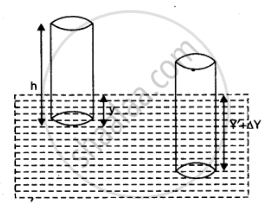
The cylindrical piece of the cork of density of base area A and height h floats in a liquid of density `rho_1`. The cork is depressed slightly and then released. Show that the cork oscillates up and down simple harmonically with a period
`T = 2pi sqrt((hrho)/(rho_1g)`
where ρ is the density of cork. (Ignore damping due to viscosity of the liquid).
Advertisements
Solution 1
Base area of the cork = A
Height of the cork = h
Density of the liquid = `rho_1`
Density of the cork = ρ
In equilibrium:
Weight of the cork = Weight of the liquid displaced by the floating cork
Let the cork be depressed slightly by x. As a result, some extra water of a certain volume is displaced. Hence, an extra up-thrust acts upward and provides the restoring force to the cork.
Up-thrust = Restoring force, F = Weight of the extra water displaced
F = –(Volume × Density × g)
Volume = Area × Distance through which the cork is depressed
Volume = Ax
∴ F = – A x `rho_1` g … (i)
According to the force law:
F = kx
`k = F/x`
Where, k is a constant
`k = F/x = -Arho_1g` ...(ii)
The time period of the oscillations of the cork:
`T = 2pi sqrt(m/k)` ...(iii)
Where
m = Mass of the cork
= Volume of the cork × Density
= Base area of the cork × Height of the cork × Density of the cork
= Ahρ
Hence, the expression for the time period becomes:
`T = 2pi sqrt((Ahrho)/(Arho_1g)) = 2 pi sqrt((hrho)/(rho_1g)`
Solution 2
Say, initially in equilibrium, y height of cylinder is inside the liquid. Then,
Weight of the cylinder = upthrust due to liquid displaced
`:. Ahrhog = Ayrho_1g`
When the cork cylinder is depressed slightly by `triangle y` and released, a restoring force, equal to additional upthrust, act on it. The restoring force is
`F = A(y + triangle y) rho_1 g - Ayrho_1g = Arho_1g triangle y`
:. Acceleration, `a = F/m = (Arho_1g triangle y)/(Ahrho) = (rho_1g)/(hrho). triangle y ` and the acceleration is directed in a direction opposite to `triangle y`. Obviously, as `a prop - triangle y`, the motion of cork cylinder is SHM, whose time period is given by
`T = 2pi sqrt("displacement"/"accelertion")`
`=2pi sqrt((triangle y)/a)`
`= 2pi sqrt((hrho)/(rho_1g))`
APPEARS IN
RELATED QUESTIONS
The period of a conical pendulum in terms of its length (l), semi-vertical angle (θ) and acceleration due to gravity (g) is ______.
The phase difference between displacement and acceleration of a particle performing S.H.M. is _______.
(A) `pi/2rad`
(B) π rad
(C) 2π rad
(D)`(3pi)/2rad`
Answer the following questions:
A time period of a particle in SHM depends on the force constant k and mass m of the particle: `T = 2pi sqrt(m/k)` A simple pendulum executes SHM approximately. Why then is the time
Answer the following questions:
The motion of a simple pendulum is approximately simple harmonic for small angle oscillations. For larger angles of oscillation, a more involved analysis shows that T is greater than `2pisqrt(1/g)` Think of a qualitative argument to appreciate this result.
Answer the following questions:
What is the frequency of oscillation of a simple pendulum mounted in a cabin that is freely falling under gravity?
A simple pendulum of length l and having a bob of mass M is suspended in a car. The car is moving on a circular track of radius R with a uniform speed v. If the pendulum makes small oscillations in a radial direction about its equilibrium position, what will be its time period?
A clock regulated by seconds pendulum, keeps correct time. During summer, length of pendulum increases to 1.005 m. How much will the clock gain or loose in one day?
(g = 9.8 m/s2 and π = 3.142)
Show that, under certain conditions, simple pendulum performs the linear simple harmonic motion.
If the particle starts its motion from mean position, the phase difference between displacement and acceleration is ______.
The relation between acceleration and displacement of four particles are given below: Which one of the particles is executing simple harmonic motion?
A particle executing S.H.M. has a maximum speed of 30 cm/s and a maximum acceleration of 60 cm/s2. The period of oscillation is ______.
When will the motion of a simple pendulum be simple harmonic?
Find the time period of mass M when displaced from its equilibrium position and then released for the system shown in figure.

A body of mass m is situated in a potential field U(x) = U0 (1 – cos αx) when U0 and α are constants. Find the time period of small oscillations.
Consider a pair of identical pendulums, which oscillate with equal amplitude independently such that when one pendulum is at its extreme position making an angle of 2° to the right with the vertical, the other pendulum makes an angle of 1° to the left of the vertical. What is the phase difference between the pendulums?
A cylindrical log of wood of height h and area of cross-section A floats in water. It is pressed and then released. Show that the log would execute S.H.M. with a time period. `T = 2πsqrt(m/(Apg))` where m is mass of the body and ρ is density of the liquid.
A pendulum of mass m and length ℓ is suspended from the ceiling of a trolley which has a constant acceleration a in the horizontal direction as shown in the figure. Work done by the tension is ______.
(In the frame of the trolley)

If the mass of the bob in a simple pendulum is increased to thrice its original mass and its length is made half its original length, then the new time period of oscillation is `x/2` times its original time period. Then the value of x is ______.
