Advertisements
Advertisements
प्रश्न
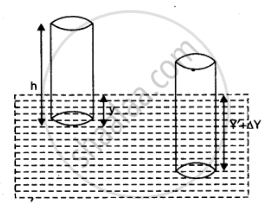
The cylindrical piece of the cork of density of base area A and height h floats in a liquid of density `rho_1`. The cork is depressed slightly and then released. Show that the cork oscillates up and down simple harmonically with a period
`T = 2pi sqrt((hrho)/(rho_1g)`
where ρ is the density of cork. (Ignore damping due to viscosity of the liquid).
Advertisements
उत्तर १
Base area of the cork = A
Height of the cork = h
Density of the liquid = `rho_1`
Density of the cork = ρ
In equilibrium:
Weight of the cork = Weight of the liquid displaced by the floating cork
Let the cork be depressed slightly by x. As a result, some extra water of a certain volume is displaced. Hence, an extra up-thrust acts upward and provides the restoring force to the cork.
Up-thrust = Restoring force, F = Weight of the extra water displaced
F = –(Volume × Density × g)
Volume = Area × Distance through which the cork is depressed
Volume = Ax
∴ F = – A x `rho_1` g … (i)
According to the force law:
F = kx
`k = F/x`
Where, k is a constant
`k = F/x = -Arho_1g` ...(ii)
The time period of the oscillations of the cork:
`T = 2pi sqrt(m/k)` ...(iii)
Where
m = Mass of the cork
= Volume of the cork × Density
= Base area of the cork × Height of the cork × Density of the cork
= Ahρ
Hence, the expression for the time period becomes:
`T = 2pi sqrt((Ahrho)/(Arho_1g)) = 2 pi sqrt((hrho)/(rho_1g)`
उत्तर २
Say, initially in equilibrium, y height of cylinder is inside the liquid. Then,
Weight of the cylinder = upthrust due to liquid displaced
`:. Ahrhog = Ayrho_1g`
When the cork cylinder is depressed slightly by `triangle y` and released, a restoring force, equal to additional upthrust, act on it. The restoring force is
`F = A(y + triangle y) rho_1 g - Ayrho_1g = Arho_1g triangle y`
:. Acceleration, `a = F/m = (Arho_1g triangle y)/(Ahrho) = (rho_1g)/(hrho). triangle y ` and the acceleration is directed in a direction opposite to `triangle y`. Obviously, as `a prop - triangle y`, the motion of cork cylinder is SHM, whose time period is given by
`T = 2pi sqrt("displacement"/"accelertion")`
`=2pi sqrt((triangle y)/a)`
`= 2pi sqrt((hrho)/(rho_1g))`
APPEARS IN
संबंधित प्रश्न
The acceleration due to gravity on the surface of moon is 1.7 ms–2. What is the time period of a simple pendulum on the surface of moon if its time period on the surface of earth is 3.5 s? (g on the surface of earth is 9.8 ms–2)
Answer the following questions:
A time period of a particle in SHM depends on the force constant k and mass m of the particle: `T = 2pi sqrt(m/k)` A simple pendulum executes SHM approximately. Why then is the time
Answer the following questions:
A man with a wristwatch on his hand falls from the top of a tower. Does the watch give correct time during the free fall?
A clock regulated by seconds pendulum, keeps correct time. During summer, length of pendulum increases to 1.005 m. How much will the clock gain or loose in one day?
(g = 9.8 m/s2 and π = 3.142)
Define practical simple pendulum
Show that, under certain conditions, simple pendulum performs the linear simple harmonic motion.
If the particle starts its motion from mean position, the phase difference between displacement and acceleration is ______.
The relation between acceleration and displacement of four particles are given below: Which one of the particles is executing simple harmonic motion?
A particle executing S.H.M. has a maximum speed of 30 cm/s and a maximum acceleration of 60 cm/s2. The period of oscillation is ______.
A body of mass m is situated in a potential field U(x) = U0 (1 – cos αx) when U0 and α are constants. Find the time period of small oscillations.
Consider a pair of identical pendulums, which oscillate with equal amplitude independently such that when one pendulum is at its extreme position making an angle of 2° to the right with the vertical, the other pendulum makes an angle of 1° to the left of the vertical. What is the phase difference between the pendulums?
A cylindrical log of wood of height h and area of cross-section A floats in water. It is pressed and then released. Show that the log would execute S.H.M. with a time period. `T = 2πsqrt(m/(Apg))` where m is mass of the body and ρ is density of the liquid.
A tunnel is dug through the centre of the Earth. Show that a body of mass ‘m’ when dropped from rest from one end of the tunnel will execute simple harmonic motion.
A simple pendulum of time period 1s and length l is hung from a fixed support at O, such that the bob is at a distance H vertically above A on the ground (Figure). The amplitude is θ0. The string snaps at θ = θ0/2. Find the time taken by the bob to hit the ground. Also find distance from A where bob hits the ground. Assume θo to be small so that sin θo = θo and cos θo = 1.

If the mass of the bob in a simple pendulum is increased to thrice its original mass and its length is made half its original length, then the new time period of oscillation is `x/2` times its original time period. Then the value of x is ______.
