Advertisements
Advertisements
Question
The class X students of a secondary school in Krishinagar have been allotted a rectangular plot of land for their gardening activity. Saplings of Gulmohar are planted on the boundary at a distance of 1 m from each other. There is a triangular grassy lawn in the plot as shown in the following figure. The students are to sow seeds of flowering plants on the remaining area of the plot.
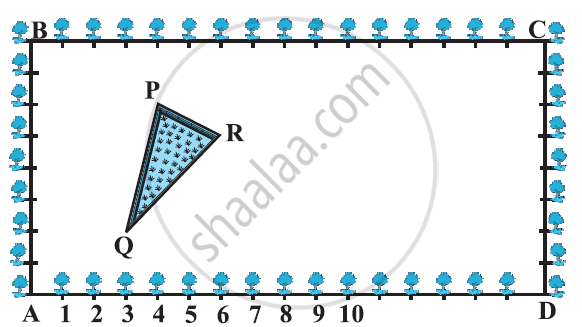
(i) Taking A as origin, find the coordinates of the vertices of the triangle.
(ii) What will be the coordinates of the vertices of Δ PQR if C is the origin?
Also calculate the areas of the triangles in these cases. What do you observe?
Advertisements
Solution
(i) Taking A as origin, we will take AD as x-axis and AB as y-axis. It can be observed that the coordinates of point P, Q, and R are (4, 6), (3, 2), and (6, 5) respectively.
Area of triangle PQR = ` 1/2[x_1(y_2-y_3)+x_2(y_3-y_1)+x_3(y_1-y_2)]`
`= 1/2[4(2-5)+3(5-6)+6(6-2)]`
`=1/2[-12-3+24]`
=`9/2` square units
(ii) Taking C as origin, CB as x-axis, and CD as y-axis, the coordinates of vertices P, Q, and R are (12, 2), (13, 6), and (10, 3) respectively.
Area of triangle PQR = `1/2[x_1(y_2-y_3)+x_2(y_3-y_1)+x_3(y_1+y_2)]`
`=1/2[12(6-3)+13(3-2)+10(2-6)]`
`=1/2[36+13-40]`
`= 9/2 ` square units
It can be observed that the area of the triangle is same in both the cases.
