Advertisements
Advertisements
Question
The adjacent sides of a parallelogram measures 34 m, 20 m and the measure of the diagonal is 42 m. Find the area of parallelogram
Advertisements
Solution
Since ABCD is a parallelogram opposite sides are equal.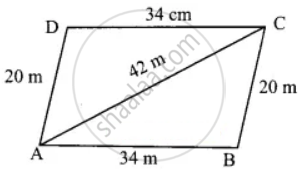
In the ΔABC
a = 20 m, b = 42 m and c = 34 m
s = `("a" + "b" + "c")/2`
= `(20 + 42 + 34)/2 "cm"`
= `96/2`
= 48 m
s – a = 48 – 20 = 28 m
s – b = 48 – 42 = 6 m
s – c = 48 – 34 = 14 m
Area of the ΔABC
= `sqrt("s"("s" - "a")("s" - "b")("s" - "c"))`
= `sqrt(48 xx 28 xx 6 xx 14)`
= `sqrt(2^4 xx 3 xx 2^2 xx 7 xx 2 xx 3 xx 2 xx 7)`
= `sqrt(2^8 xx 3^2 xx 7^2)`
= 24 × 3 × 7 sq.m
= 16 × 3 × 7 sq.m
= 336 sq.m
Since ABCD is a parallelogram
Area of ΔABC and Area of ΔACD are equal
Area of the parallelogram ABCD = (336 + 336) sq.m
= 672 sq.m
∴ Area of the parallelogram = 672 sq.m
APPEARS IN
RELATED QUESTIONS
Area of PQRS = Area of PQR + Area of ΔPQS = (6+9.166)𝑐𝑚2=15.166𝑐𝑚2
Find the perimeter and area of the quadrilateral ABCD in which AB = 17 cm, AD =9 cm, CD = l2cm, ∠ACB = 90° and AC=l5cm.
The perimeter of a triangullar field is 144 m and the ratio of the sides is 3 : 4 : 5. Find the area of the field.
If the area of an isosceles right triangle is 8 cm2, what is the perimeter of the triangle?
The lengths of the sides of Δ ABC are consecutive integers. It Δ ABC has the same perimeter as an equilateral triangle with a side of length 9 cm, what is the length of the shortest side of ΔABC?
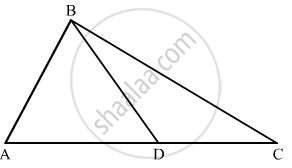
In the given figure, the ratio AD to DC is 3 to 2. If the area of Δ ABC is 40 cm2, what is the area of Δ BDC?
Find the area of a quadrilateral ABCD whose sides are AB = 13 cm, BC = 12 cm, CD = 9 cm, AD = 14 cm and diagonal BD = 15 cm
The length of each side of an equilateral triangle having an area of `9sqrt(3)`cm2 is ______.
If the area of an equilateral triangle is `16sqrt(3)` cm2, then the perimeter of the triangle is ______.
The area of the equilateral triangle is `20sqrt(3)` cm2 whose each side is 8 cm.
