Advertisements
Advertisements
Question
The adjacent diagram shows four solid plastic balls with wires fitted on a wooden base. A person shakes the wooden base to and fro (forward and backward) periodically. It is observed that even the balls start vibrating. It is also observed that all balls vibrate, but only one ball vibrates vigorously.
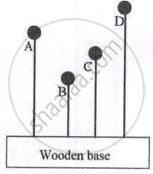
- Explain why only one ball vibrates vigorously.
- If fA, fB,fC, and fD are the natural frequencies of vibration of the wires, then arrange them in the increasing order of their frequencies and give reasons for the same.
Advertisements
Solution
(a) When the wooden base is shaken periodically, it exerts an external periodic force on all the wires, forcing them into forced vibrations.
However, only one ball vibrates vigorously because of the phenomenon of resonance. This happens because the frequency of the external periodic force (the shaking of the base) matches the natural frequency of that specific wire-ball system. At resonance, the system absorbs maximum energy from the driving force, causing it to vibrate with a very large amplitude.
(b) Increasing Order of Frequencies:
fD < fA < fC < fB
The natural frequency (f) of a vibrating wire is inversely proportional to its length (l). A longer wire produces a lower natural frequency, while a shorter wire produces a higher natural frequency (\(f \propto \frac{1}{\text{length}}\)). Looking at the given diagram, the lengths of the wires follow this order from longest to shortest:
Length of D > Length of A > Length of C > Length of B
Therefore, wire D (being the longest) has the lowest natural frequency, and wire B (being the shortest) has the highest natural frequency.
