Advertisements
Advertisements
Question
Talk to any one of your grandparents or any other elderly person. Find out, when she or he was eight-nine years old -
- Where did she or he live? Name that place.
- From what material was her or his house made?
- Did they have a toilet in their house? If no, where was it?
- In which part of the house was food cooked?
- A lot of mud was used when Chetandas' house was made. Why?
Advertisements
Solution
- He lived in a village named Chennai.
- His house was made of materials like wood, thatched bamboo, mud and straw.
- Yes, they had a toilet in their house.
- Their food was cooked in the verandah which was separated by a wall.
- Because a thick layer of mud protects the house from cold and heat.
APPEARS IN
RELATED QUESTIONS
What material have been used in making your house?
What kind of house do you think Chetandas' grandchildren will live in?
Where would you like to live when you grow up? What kind of house would you like?
You had written about the things that your grandparent’s house was made of. Has some of those materials been used in your house? Name them.
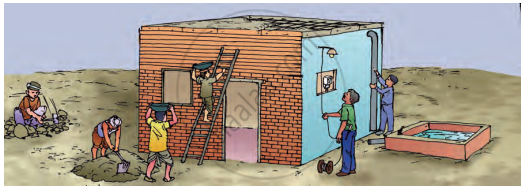
Look at the picture. People are given names according to the work they do. For example, a person who works with wood is called a carpenter.
In your place, what do you call a person who works with wood?
Now, look at the picture and fill in the table.
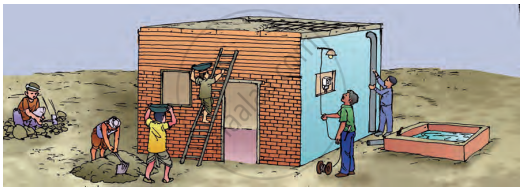
What kind of work is being done by different people here?
What tools are they shown using in the picture? Write them in the given table.
| Work | Tool | What is the person called |
| 1. | ||
| 2. | ||
| 3. | ||
| 4. |
Do you know people who do these type of work? Talk to them and find out about their work. Discuss it with your friends.
With your teacher or someone from home, go to a place where a building is being constructed. Talk to the people working there and find out answers to these questions.
- What is being built there?
- How many people are working there?
- What kind of work are they doing?
- How many men and women are there?
- Are any children working there? What are they doing?
- How much money do these people get paid daily? Ask from any three different people.
- Where do these people live?
- What are the materials being used for making the building?
- Try and guess how many trucks of bricks and bags of cement will be used for making the building.
How does the material reach the building site? (By truck, handcart, any other vehicle) List them.
Ask a few other questions and write their answers.
Over the sixty years, different materials were used at different times in Chetandas’ house. List these in the correct order.