Advertisements
Advertisements
Question
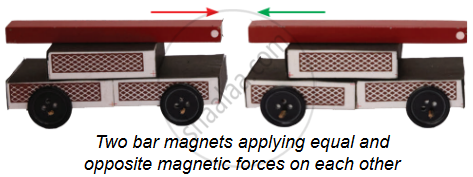
Take two toy cars of equal mass and stick a bar magnet on top of each (Fig.). Fix a metre scale on a smooth surface. Place the cars near the midpoint of the metre scale with the like poles touching. Release the cars and record the time taken (using two stopwatches), and distance travelled by each before coming to a rest. Repeat the experiment after adding equal masses to both cars. Did the cars travel equal distances in opposite directions? Plot a graph of distance travelled versus mass. Analyse and discuss your findings.
Advertisements
Solution
Yes, the two cars will move equal distances in opposite directions because they experience equal and opposite forces under symmetrical conditions.
1. Analysis of the Findings
- Newton’s Third Law (Action–Reaction): The magnetic force exerted by Car A on Car B is equal in magnitude and opposite in direction to the force exerted by Car B on Car A.
- Symmetry in Motion: Since both cars have the same mass and face similar surface friction, they accelerate equally in opposite directions. As a result, they attain similar speeds and travel equal distances before coming to rest.
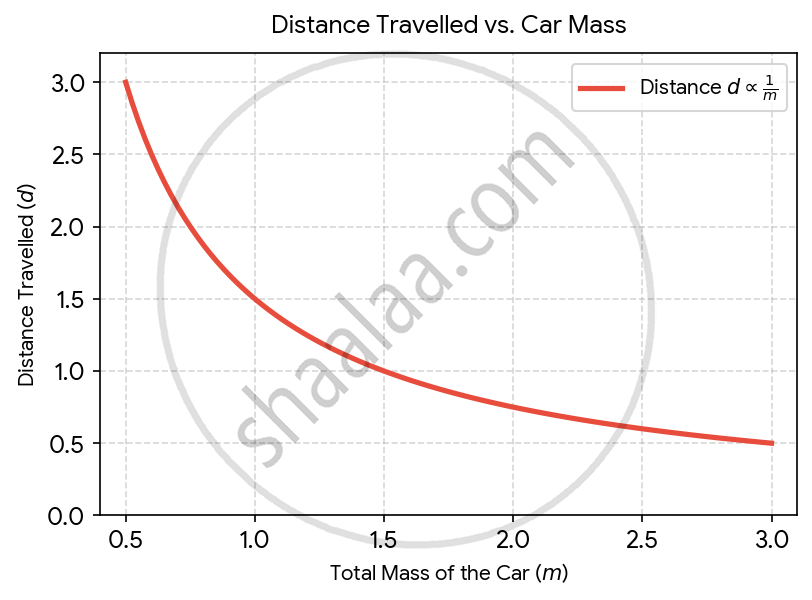
- Effect of Increasing Mass: When equal masses are added to both cars, the symmetry is still maintained, so both cars continue to move equal distances in opposite directions. However, due to increased inertia, both cars travel shorter distances than before.
2. Distance vs. Mass Relationship Graph
The chart below shows how the total distance travelled changes as you increase the mass of the cars:
- Work–Energy Principle: The potential energy present between the magnetic poles when they are in contact remains constant (U). This energy gets converted into the motion of the cars and is eventually fully lost due to frictional forces, where the work done by friction equals force × distance.
- Energy Loss due to Friction: Frictional force is given by μmg. By applying the energy balance:
U = μmgd ⇒ d = `U/(μgm)` - Mathematical Conclusion: Since the magnetic energy (U), gravitational acceleration (g), and coefficient of friction (μ) remain unchanged, the distance travelled (d) varies inversely with mass (m). Therefore, heavier cars cover a shorter distance because increased mass increases frictional resistance, causing energy to be dissipated more quickly.
