Advertisements
Advertisements
Question
Take five different types of big vessels from your kitchen.
Fill all of them one by one with one jug full of water.
What do you see? Why?
Talk to your friends about it.
Advertisements
Solution
Children will have to do this activity on their own.
APPEARS IN
RELATED QUESTIONS
Look at these pictures. Now look for some other things we get in packets or bottles like these. Make your own list.
 |
 |
 |
 |
 |
 |
| Packet | How many mL or L? |
| Milk | 500 mL |
 |
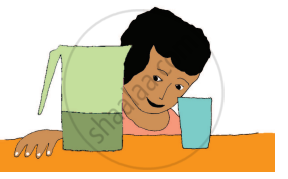 |
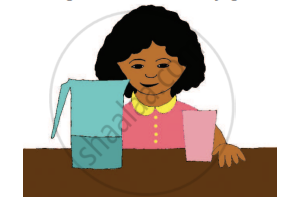
Whose jug holds more water?
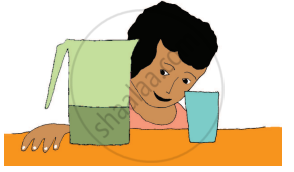
If Jeetu pours one more glass of water his jug will be around ______ full.
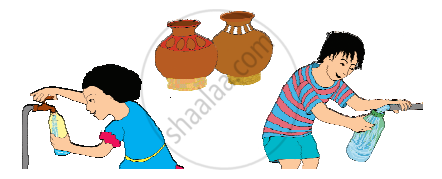
Naseem had to fill her bottle 16 times from the tap. But Abdul had to fill his bottle only 8 times.
Why did Naseem go more times than Abdul?
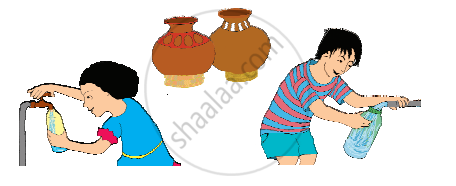
Naseem's bottle can hold ______ as much water as Abdul's bottle.
Get a 1 litre bottle (can be an empty bottle of water, oil etc.). Now collect some bottles and a mug, jug, glass, bowl, etc. at your house. Use the 1 litre bottle to check which of these holds more than 1 litre and which one holds less than 1 litre. Make a small drawing if you like.
| Less than 1 litre | More than 1 litre |
| bowl | big cooking pot |
Match the Right Pairs
| About 12 liters |
(to measure milk) |
| Less than Half litre |
(water tank) |
| About 5 litres |
(bucket) |
| 1000 litres |
(eye drops bottle) |
| Half litre |
(water suraahi) |

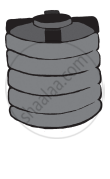


Mark A, B, C on the right hole in the picture.
For making 6 glasses of lemon drink –
- How many lemons will you need?
- How many spoons of sugar will you take?
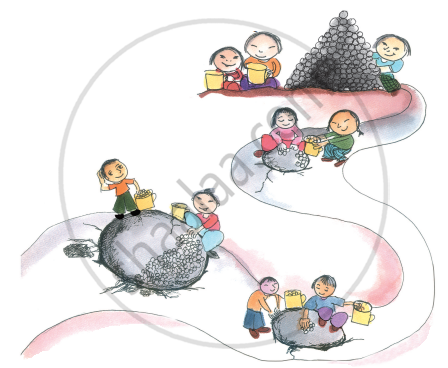
Chirpy crow was very thirsty. It looked everywhere but could not find water. Suddenly it saw a  pitcher (matka). When it tried to drink water, it found there was very little water in the
  pitcher.
It saw  pebbles lying nearby.
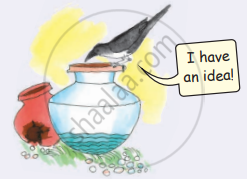
It put the pebbles into the pitcher one by one.
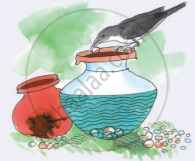
The water came up  .
.
Chirpy drank water and flew away.
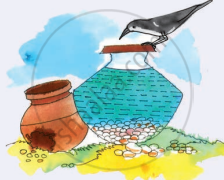
What will you do if you were at the crow's place?
