Advertisements
Advertisements
Question
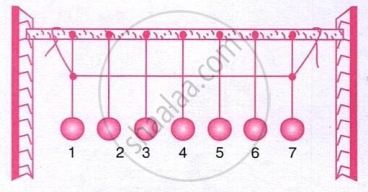
Take a metre scale and suspend 7 simple pendulums on the metre scale in such a way that the pendulums 2, 3, 4, 5 and 6 of equal length are approximately placed equidistant from each other (say 10 cm apart). Keep the pendulums 1 and 7 of bigger length at a slightly longer distance from the pendulums 2 and 6 respectively (say ~11 cm away). Now pass a string at right angles to each of the strings tying firm knots, wherever the string meets each of the seven strings. Get an arrangement of the pendulums as shown in Fig. 2 so that you get pendulums of equal lengths which are placed equidistant from each other.
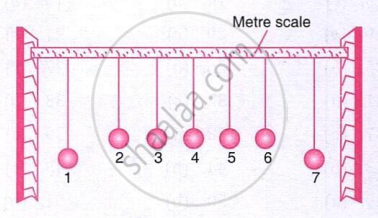
Displace the pendulum 1 to one side so as to set it into oscillations (in a plane perpendicular to the plane of strings) shown in Fig. 2 (Take care that the bobs do not collide as they oscillate.)
Observe the bobs 1 and 2 carefully. What do you see? It will be noticed that gradually the bob 2 picks up oscillation while the bob 1 starts losing until it (bob 1) completely stops oscillating. This process goes on between pendulums 2 and 3, then between 3 and 4 until the last bob starts oscillating. The experiment clearly explains that the oscillation or the disturbance given to the pendulum 1 is passed on to the pendulum 2. The pendulum 2 passes this disturbance to pendulum 3 till it reaches the last pendulum. In other words, the oscillation of the first pendulum passes on to the last pendulum without having come in contact with each other. Such disturbances are called waves.
A wave is defined as a disturbance which travels with finite velocity through a medium and remains unchanged in type as it travels. Waves travel through space or matter. Heat and light rays from the sun travel through space. Sound waves travel through matter (solids, liquids and gases). Sound is also ‘this kind’ of a disturbance or a wave. When you speak, your vocal cords vibrate. These vibrations disturb the air molecules close to your mouth. These in turn disturb their neighbouring molecules. The neighbouring molecules disturb their neighbours and the disturbance is passed on. This disturbance in turn disturbs the molecules close to the listener’s ear and makes them oscillate.
Then these oscillating molecules strike the eardrum and make it vibrate. These vibrations are carried to the brain through nerve connections and the brain decodes these vibrations into sound. Very weak, quiet sounds cannot be heard because the waves do not have enough energy to vibrate the eardrum.
This situation is similar to a convoy of cars (number of cars) regularly spaced, moving along a highway. When the driver of the first car applies brakes, at a traffic signal, all the drivers behind him also do the same. In this case, applying brakes is a disturbance, and it is this disturbance which propagates from the front to the back of the convoy setting up a wave motion.
Advertisements
Solution
1. Observation
- Bob 1 is displaced and set into oscillation; bob 2 is initially at rest.
- After some time, bob 2 starts oscillating with increasing amplitude while bob 1 starts losing amplitude.
- When bob 2 has maximum amplitude, bob 1 is nearly stopped. Bob 2 then passes the disturbance to bob 3, and so on until the last bob oscillates.
- Pendulum 7, being of different length, responds much less strongly than the equal-length pendulums 2 to 6.
2. Reason
- The equal-length pendulums have the same natural frequency because \[ T = 2\pi\sqrt{\frac{l}{g}}\].
- Hence [ f = \frac{1}{T} ] is also the same for pendulums 2, 3, 4, 5 and 6.
- When bob 1 oscillates, it makes the common string/scale vibrate. This provides a periodic driving force to bob 2.
- Because bob 2 has nearly the same natural frequency as bob 1, resonance occurs and energy is transferred efficiently to bob 2.
3. Wave connection
- The oscillation/disturbance travels from pendulum 1 to pendulum 7 without the pendulums touching one another.
- The bobs do not move permanently from one place to another; only energy is passed from one particle/bob to the next.
- Therefore, the activity demonstrates wave motion: a disturbance carrying energy through a medium without net transfer of matter.
Conclusion: We see sympathetic oscillations where energy transfers from bob 1 to bob 2, then 2 to 3, etc.; this is a simple demonstration of wave motion.
