Advertisements
Advertisements
Question
Suppose a consumer wants to consume two goods that are available only in integer units. The two goods are equally priced at Rs 10 and the consumer’s income is Rs 40.
(i) Write down all the bundles that are available to the consumer.
(ii) Among the bundles that are available to a consumer, identify those that cost will him/her exactly Rs 40.
Advertisements
Solution
(i) P1 = Rs 10
P2 = Rs 10
M = Rs 40
Budget set ⇒ P1x1 + P2x2 ≤ M
10x1 + 10x2 ≤ 40
x1 + x2 ≤ 4 ...(Divided by 10)
The bundles that are available to the consumer should cost less than or equal to Rs 40.
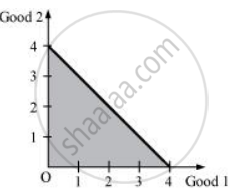
Horizontal intercept `= M/P_1 = 40/10 = 4`
Vertical intercept ` = M/P_2 = 40/10 = 4`
Slope ` = (-P_1)/P_2 = (-10)/10 = -1`
The bundles in the shaded region (ΔAOB) are all available to the consumer, including the bundles lying on the line AB.
|
(0,0) |
(0, 1) |
(0, 2) |
(0, 3) |
(0, 4) |
|
(1, 0) |
(1, 1) |
(1, 2) |
(1, 3) |
|
|
(2, 0) |
(2, 1) |
(2, 2) |
||
|
(3, 0) |
(3, 1) |
|||
|
(4, 0) |
(ii) The coordinates that lie on the line AB cost exactly the same as the income of the consumer. The bundles are as follows:
(0, 4), (1, 3), (2, 2), (3, 1), (4, 0)
APPEARS IN
RELATED QUESTIONS
Define budget set.
Explain the meaning of Budget line.
A consumer buys 200 units of a good at a price of Rs 20 per unit. Price elasticity of deamnd is (–) 2. At what price will he be willing to purchase 300 units? Calculate.
Write a budget line equation of a consumer if the two goods purchased by the consumer, Good X and Good Y are priced at Rs 10 and Rs 5 respectively and the consumer's income is Rs 100.
Find Consumption Expenditure from the following:
|
National Income |
= Rs 5,000 |
|
Autonomous Consumption |
= Rs 1,000 |
|
Marginal propensity to consume |
= 0.80 |
What do you mean by the budget set of a consumer?
What is a budget line?
Explain why the budget line is downward sloping.
A consumer wants to consume two goods. The prices of the two goods are Rs 4 and Rs 5 respectively. The consumer’s income is Rs 20.
How much of good 1 can the consumer consume if he/she spends his/her entire income on that good?
A consumer wants to consume two goods. The prices of the two goods are Rs 4 and Rs 5 respectively. The consumer’s income is Rs 20.
How much of good 2 can be consumed if he/she spends his/her entire income on that good?
A consumer wants to consume two goods. The prices of the two goods are Rs 4 and Rs 5 respectively. The consumer’s income is Rs 20.
What is the slope of the budget line?
How does the budget line change if the price of good 2 decreases by a rupee but the price of good 1 and the consumer’s income remain unchanged?
What happens to the budget set if the prices as well as the income double?
Suppose a consumer can afford to buy 6 units of good 1 and 8 units of good 2 if he/she spends her entire income. The prices of two goods are Rs 6 and Rs 8. How much is the consumer’s income?
Suppose a consumer whose budget is ₹ 500, wants to consume only two goods, Good X and Good Y. The goods are respectively priced at ₹ 50 and ₹ 25.
Answer the following questions on the basis of the given information:
(a) State the budget equation of the consumer.
(b) What is the slope of the budget line?
(c) How many units can she purchase if she spends the entire ₹ 500 on Good X?
(d) How many units can she purchase if she spends the entire ₹ 500 on Good Y, given that the price of good Y has doubled?
Answer the following question.
What can cause a change in the budget line? Explain.
