Advertisements
Advertisements
Question
Study the picture and answer the questions that follow.
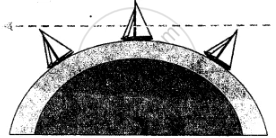
(a) What does the picture show you about the earth?
(b) State briefly the Bedford Level Experiment.
(c) The sun rises and sets at different times in different places. What does the statement show the shape of the earth?
(d) In what way is the earth’s atmosphere beneficial to mankind?
Advertisements
Solution
(a) The picture shows the spherical shape of the earth.
(b) Three pillars of equal height were put along the Bedford Level canal area in England each at 5 km. interval. After observation, it came to know that the middle pole was higher than the sideward poles. This proved that the earth’s surface was curved and the earth is a spherical body.
(c) The times of sunset and sunrise are different in the different parts of the earth because the earth moves from west to east and the places situated in the east get sunrise first. Japan is called the land of the rising sun, as it is in the eastern-most part of the Eastern Hemisphere and the date starts from the Eastern Hemisphere. It proves that the earth is spherical.
(d) The atmosphere is indispensable for life on earth, as it provides air to inhale; rainfall and freshwater bodies after the hydrological cycle. Moreover, it absorbs the extremely hot ultraviolet rays of the sun and makes the temperature ideal on earth. Other planets are either very hot or very cold due to the absence of an atmosphere.
