Advertisements
Advertisements
Question
Statement A (Assertion): If the coordinates of the mid-points of the sides AB and AC of ∆ABC are D(3, 5) and E(–3, –3) respectively, then BC = 20 units.
Statement R (Reason): The line joining the mid-points of two sides of a triangle is parallel to the third side and equal to half of it.
Options
Both assertion (A) and reason (R) are true and reason (R) is the correct explanation of assertion (A).
Both assertion (A) and reason (R) are true and reason (R) is not the correct explanation of assertion (A).
Assertion (A) is true but reason(R) is false.
Assertion (A) is false but reason(R) is true.
Advertisements
Solution
Both assertion (A) and reason (R) are true and reason (R) is the correct explanation of assertion (A).
Explanation:
Statement A (Assertion): If the coordinates of the mid-points of the sides AB and AC of ∆ABC are D(3, 5) and E(–3, –3) respectively, then BC = 20 units.
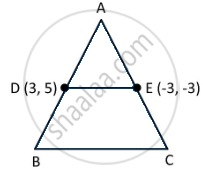
We need to use the theorem in Reasoning
The line joining the mid-points of two sides of a triangle is parallel to the third side and equal to half of it.
DE = `1/2` BC
2DE = BC
BC = 2DE
BC = `2 xx sqrt((-3 - 3)^2 + (-3 - 5)^2)`
BC = `2 xx sqrt((-6)^2 + (-8)^2)`
BC = `2 xx sqrt(6^2 + 8^2)`
BC = `2 xx sqrt(36 + 64)`
BC = `2 xx sqrt(100)`
BC = 2 × 10
BC = 20 cm
Thus, Assertion is true.
Statement R (Reason): The line joining the mid-points of two sides of a triangle is parallel to the third side and equal to half of it.
This is always true.
Here is a proof
In ΔABC,
D is the mid-point of AB
⇒ AD = DB
⇒ `(AD)/(DB)` = 1 ......(1)
E is the mid-point of AC
⇒ AE = EC
⇒ `(AE)/(EC)` = 1 ......(2)
From (1) and (2)
`(AD)/(DB) = (AE)/(EC)` .....(If a line divides any two sides of a triangles in the same ratio, 3 then the line is parallel to the third side)
∴ DE || BC
Hence proved
Thus, Reasoning is true.
