Advertisements
Advertisements
Question
State the function of a split ring in D.C. motor.
Advertisements
Solution
When the coil of a D. C motor turns through 180°, the split ring reverses the direction of the current in the coil from CBAD to DABC.
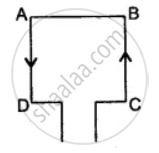

In this way, the coil continues to rotate continuously in the same direction and positive and negative polarities are maintained.
RELATED QUESTIONS
How will you make an iron bar electromagnet? Draw a diagram showing the polarities of the electromagnet?
Suppose you are given a long bar magnet and you are asked to break it into four small magnets. Draw diagrams showing the polarities of each broken part.
Tick the most appropriate answer.
Which of the following methods is used to magnetize a magnetic without touching it by a magnet?
A straight current-carrying conductor is kept in a magnetic field. It Experiences a force. State three factors on which the magnitude of force Experienced by the conductor depends. Under what condition will the conductor Experience no force?
State three factors which govern the speed of rotation of an electric motor.
State the principle of a D. C. motor.
State the position of armature coil relative to the direction of magnetic field, in a D. C. motor when the deflecting couple acting an the coil is maximum.
State important properties (or characteristics) of magnetic lines of force around a straight conductor.
What are the factors that govern the magnitude of force acting on a current carrying conductor which is freely suspended in a magnetic field?
Point out three differences between an electromagnet and a bar (or permanent) magnet.
