Advertisements
Advertisements
Question
State the difference between meiocyte and gamete with respect to chromosome number.
Advertisements
Solution
A meiocyte is a diploid (2n) cell containing two sets of chromosomes, while a gamete is a haploid (n) cell containing only one set of chromosomes. Thus, meiocytes have double the chromosome number compared to gametes.
RELATED QUESTIONS
If centromere is situated in the middle of the chromosome, it is called ________.
(a) Metacentric
(b) Acrocentric
(c) Submetacentric
(d) Telocentric
Classify the chromosomes on the basis of position of centromere.
Describe the structure of sex-chromosomes.
Choose the correct options of the following question:
Study the given monohybrid cross:
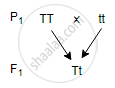
A test cross for this Fj will be:
Short Answer Question.
Explain the chromosomal theory of inheritance.
If the haploid number in a cell is 18. The double monosomic and trisomic number will be
Changing the codon AGC to AGA represents
Which of the following is a primary constriction?
From the following identify the INCORRECT statement/s with respect to the chromosomes.
i. Chromosomes are capable of self replication and play vital role in heredity, mutation, variation, and evolutionary development of eukaryotic species.
ii. Chromosomes are visible during cell division.
iii. Chemically eukaryotic chromosomes are made of mRNA, histone and non-histone proteins.
iv. The number of chromosomes varies within the population of a particular species.
Identify the term that represents the degree of repetition of the primary basic number of chromosomes in a cell.
Extra nuclear chromosomes occur in ______.
In a certain taxon of insects some have 17 chromosomes and the others have 18 chromosomes. The 17 and 18 chromosome-bearing organisms are ______.
Experimental verification of ‘chromosomal theory of inheritance’ was done by ______.
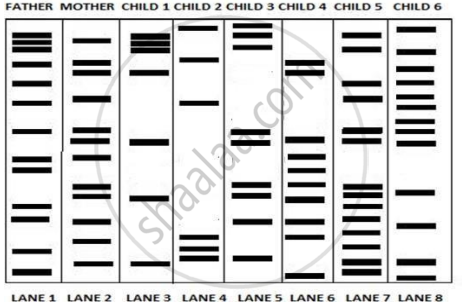
There was a mix-up at the hospital after a fire accident in the nursery division. Which of these children belong to the parents?
What do you mean by locus?
Experimental verification of the chromosomal theory of inheritance was done by ______.
Which chromosome in the human genome has the highest number of genes?
According to the Chromosomal Theory of Inheritance, what are the specific positions on chromosomes where genes are located called?
The Chromosomal Theory of Inheritance is also known by which alternative name?
In what year did Walter Sutton publish the formal paper "The Chromosomes in Heredity" that linked Mendel's laws to chromosome behaviour?
