Advertisements
Advertisements
Question
State the basic proportionality theorem. Use the theorem to prove the following:
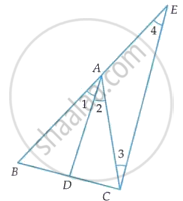
In ΔABC, AD is the angle bisector of angle A. BA is produced to E such that CE || AD. Prove that `(BD)/(DC) = (BA)/(AC)`.
Advertisements
Solution
Given:
In ΔABC, AD is the internal bisector of ∠A.
BA is produced to E (so B, A, E are collinear) and CE || AD.
To Prove: `(BD)/(DC) = (BA)/(AC)`
Proof (Step-wise):
1. Consider ΔBCE. The line AD meets BE at A and BC at D and AD || CE by hypothesis.
Hence, by the Basic Proportionality Theorem applied to ΔBCE, we get `(BA)/(AE) = (BD)/(DC)`.
2. Show AE = AC.
Since CE || AD, ∠ACE (angle between AC and CE) equals ∠CAD (alternate interior angles).
Also CE || AD and AE is the extension of AB, so ∠AEC (angle between AE and EC) equals ∠BAD (alternate interior angles).
But AD is the angle bisector, so ∠BAD = ∠CAD.
Therefore ∠AEC = ∠ACE, so ΔAEC is isosceles and hence AE = AC.
3. Substitute AE = AC into the relation from step 1:
`(BD)/(DC) = (BA)/(AE) = (BA)/(AC)`.
Thus `(BD)/(DC) = (BA)/(AC)`, as required.
