Advertisements
Advertisements
Question
State the condition when a force produces
(i) linear motion.
(ii) rotational motion, in a body.
Advertisements
Solution
(i) If a rigid body is free to move, the applied force will cause translational motion.
(ii) If a rigid body moves around a center or is pivoted at a point, the applied force will cause rotational motion.
APPEARS IN
RELATED QUESTIONS
When a body is placed on a table top, it exerts a force equal to its weight downwards on the table top but does not move or fall
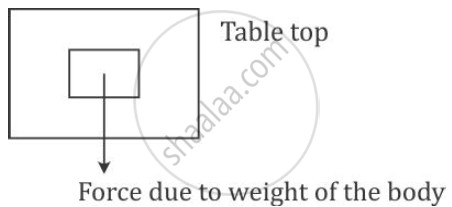
1) Name the force exerted by the table top
2) What is the direction of the force?
Give the expression for mechanical advantage of an inclined plane in terms of the length of an inclined plane.
A man having a box on his head, climbs up a slope and another man having an identical box walks the same distance on a levelled road.
Who does more work against the force of gravity and why?
How is kilowatt hour related to joule?
Name the quality which is measured in kWh.
What is meant by a rotatory motion? Give one example.
What do you mean by equilibrium of a body?
What do you understand by work? Is work a scalar or a vector quantity?
State two conditions for work to be done.
A coolie carrying a load on his head and moving on a frictionless horizontal platform does no work. Explain the reason why.
