Advertisements
Advertisements
Question
State briefly the modern views on magnetism.
Advertisements
Solution
The molecular theory of magnetism was a considerable step forward but later there came an electrical explanation for the magnetism of atoms and this had wider applications. We have already seen that magnets can be made by an electric current. Atoms contain particles of electricity called electrons that move in orbits about a central nucleus. These electrons behave like an electric current in a single turn of wire and so create a magnetic field. More importantly, the electrons are also spinning like tops and this adds further magnetism to the atom.
The apparently non-magnetic substances are classified as either diamagnetic or paramagnetic respectively. We shall explain these terms very briefly before going on to deal with the strongly magnetic or ferromagnetic substances.
APPEARS IN
RELATED QUESTIONS
The strength of the magnetic field between the poles of an electromagnet would be unchanged if ______.
A thick wire is hanging form a wooden table. An anticlockwise magnetic field is to be produced around the wire by passing current through this wire by using a battery. Which terminal of the battery should be connected to the:
(a) top end of wire?
(b) bottom end of wire?
Give reason for your choice.
What is a lodestone?
The intensity of a magnetic field is indicated by the lines of ______.
Draw diagram showing the arrangement of the lines of force for a piece of soft iron laid in line with the magnetic field.
State any two properties of a magnet.
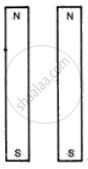
Complete the following diagram of magnets to show the lines of force.
Distinguish between
Magnetic properties of iron and steel.
If the key in the arrangement is taken out (the circuit is made open) and magnetic field lines are drawn over the horizontal plane ABCD, the lines are

A closely wounded circular coil of radius 5 cm produces a magnetic field of 37.68 × 10⁻⁴ T at its center. The current through the coil is ______ A. [Given, number of turns in the coil is 100 and π = 3.14)
