Advertisements
Advertisements
प्रश्न
State briefly the modern views on magnetism.
Advertisements
उत्तर
The molecular theory of magnetism was a considerable step forward but later there came an electrical explanation for the magnetism of atoms and this had wider applications. We have already seen that magnets can be made by an electric current. Atoms contain particles of electricity called electrons that move in orbits about a central nucleus. These electrons behave like an electric current in a single turn of wire and so create a magnetic field. More importantly, the electrons are also spinning like tops and this adds further magnetism to the atom.
The apparently non-magnetic substances are classified as either diamagnetic or paramagnetic respectively. We shall explain these terms very briefly before going on to deal with the strongly magnetic or ferromagnetic substances.
APPEARS IN
संबंधित प्रश्न
Explain why, two magnetic field lines of not intersect each other.
In the straight wire A, current is flowing in the vertically downwards direction whereas in wire B the current is flowing in the vertically upward direction. What is the direction of magnetic field:
(a) in wire A?
(b) in wire B?
Name the rule which you have used to get the answer.
A charged particle enters at right angles into a uniform magnetic field as shown:
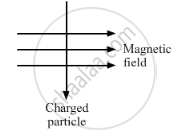
What should be the nature of charge on the particle if it begins to move in a direction pointing vertically our of the page due to its interaction with the magnetic field?
What is a natural magnet? State two limitations of a natural magnet.
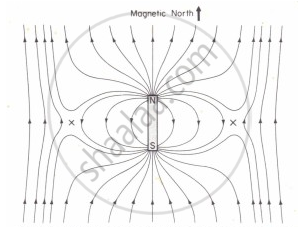
Draw the pattern of magnetic field lines near a bar magnet placed with its North Pole pointing towards the geographic North. Indicate the position of neutral points by marking X.
Figure. shows a bar magnet placed on the table top with its north pole pointing towards south. The arrow shows the north-south direction. There are no other magnets or magnetic materials nearby.
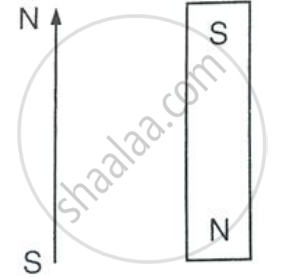
Insert two magnetic field lines on either side of the magnet using arrow head to show the direction of each field line.
In a uniform magnetic field, the field lines are:
Select the correct option:
Nickel is a:
Describe two methods of determining the arrangement of the lines of force in the field close to a bar magnet. Give a brief explanation of each method.
Draw diagram showing the arrangement of the lines of force for a piece of soft iron laid in line with the magnetic field.
