Advertisements
Advertisements
प्रश्न
State briefly the molecular theory of magnetism.
Advertisements
उत्तर
- Each molecule of a magnetic substance, whether it is magnetized or unmagnetized, is an independent magnet.
- In a magnetized substance, the molecules are arranged in an order so as to produce an external effect. In this order, all the north poles of the molecules of the magnetized substances point to one direction and all their south poles point to a direction opposite to that to which their north poles points.

- In an unmagnetized substance, the molecules are not arranged in any order, so they neutralize the magnetic forces of each other.
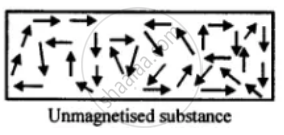
- The molecular theory of magnetism was a considerable step forward but later there came an electrical explanation for the magnetism of atoms.
Atoms consist of negatively charged particles (electrons) that revolve around the positively charged nucleus. Electrical current loops are formed in an atom due to the circulation of these electrons. Each current loop behaves a magnetic dipole and hence produce a magnetic field. Also, electrons are also spinning like tops and this adds further magnetism to the atom.
संबंधित प्रश्न
Draw a diagram to show the magnetic field lines around a bar magnet.
The figure given below shows the magnetic field between two magnets:
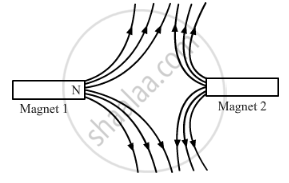
Copy the diagram and label theother poles of the magnets.
Which is the weaker magnet?
What is an artificial magnet? State two reasons why do we need artificial magnets .
Explain the following :
When two pins are hung by their heads from the same pole of a magnet, their pointed ends moves apart.
What do you understand by the term magnetic field lines?
Select the correct option:
The magnetic strength of a bar magnet is:
Draw diagram showing the arrangement of the lines of force for a single magnet.
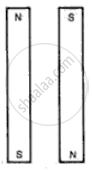
Complete the following diagram of magnets to show the lines of force.
What are the properties of a magnet?
A magnetic needle is kept in a non-uniform magnetic field. It experiences ______.
