Advertisements
Advertisements
Question
State any three of its importance in sustainable agriculture.
Advertisements
Solution
The advantages of IPM are listed as follows:
- Slower development of resistance to pesticides: Pests typically become resistant to insecticides over time. The pests' genes will be passed on to their offspring if they survive the chemical application. 'Super-pests' are the result of this. IPM lowers the likelihood and hazards of these situations.
- Maintaining a balanced ecosystem: Using pesticides could eliminate non-targeted organisms and the pest population. Excessive use of pesticides typically causes beneficial bacteria in the soil to disappear. IPM keeps the natural world in balance.
- Reduced risk to farm workers: Overexposure to the hazardous chemicals in pesticides causes various health concerns for farmers and their families, including skin infections and respiratory disorders. IPM lowers the dangers to farmers' and their families' health.
APPEARS IN
RELATED QUESTIONS
State two advantages of High Yield Variety seeds.
Give one difference between Polyvarietal cultivation and Polyculture.
What is Trickle or Drip Irrigation?
What is Conservation Tillage?
State any two disadvantages of Mixed Cropping.
Choose the incorrect pair from the following:
Write three advantages of Integrated Pest Management (IPM).
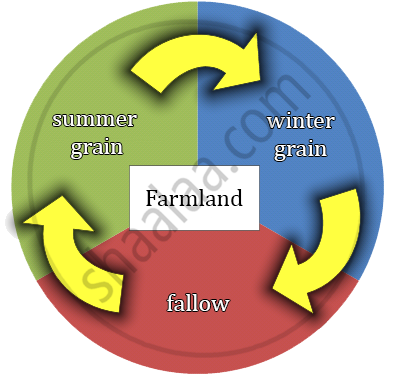
What type of regenerative farming technique is depicted in the image given below?
The Green Revolution in the late 1960’s introduced the Indian farmers in cultivation of wheat and rice, which produced greater amounts of grain. The farmers did not use traditional seeds.
- What type of seeds were used by the farmers?
- Write one disadvantage of these seeds.
List two differences between chemical fertilizers and organic fertilizers.
