Advertisements
Advertisements
Question
State and write the mathematical expression for Dalton’s law of partial pressure and explain it with a suitable example.
Advertisements
Solution
Dalton’s law of partial pressure:
- Statement: The total pressure of a mixture of two or more non-reactive gases is the sum of the partial pressures of the individual gases in the mixture.
- Explanation:
Dalton’s law can be mathematically expressed as:
PTotal = P1 + P2 + P3 …(at constant T and V)
where, PTotal is the total pressure of the mixture and P1, P2, P3, … are the partial pressures of individual gases 1, 2, 3, … in the mixture.
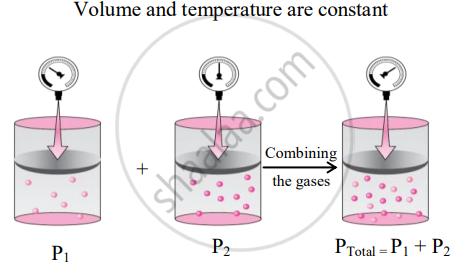
For example, consider two non-reactive gases A and B. On mixing the two gases, the pressure exerted by individual gas A in the mixture of both the gases is called partial pressure of gas A (say P1). Likewise, the partial pressure of gas B is P2. According to Dalton’s law, the total pressure of the mixture of gas A and B at constant T and V will be given as:
PTotal = P1 + P2 - Schematic illustration of Dalton’s law of partial pressures:
APPEARS IN
RELATED QUESTIONS
Solve the following.
Nitrogen gas is filled in a container of volume 2.32 L at 32°C and 4.7 atm pressure. Calculate the number of moles of the gas.
Solve the following.
At 25°C and 760 mm of Hg pressure, a gas occupies 600 mL volume. What will be its pressure at the height where the temperature is 10°C and the volume of the gas 640 mL?
Solve the following.
Calculate the number of molecules of methane in 0.50 m3 of the gas at a pressure of 2.0 × 10² kPa and a temperature of exactly 300 K.
At identical temperature and pressure, the rate of diffusion of hydrogen gas is `3sqrt3` times that of a hydrocarbon having molecular formula CnH2n–2. What is the value of n?
Equal moles of hydrogen and oxygen gases are placed in a container, with a pin-hole through which both can escape what fraction of oxygen escapes in the time required for one-half of the hydrogen to escape.
The variation of volume V, with temperature T, keeping the pressure constant is called the coefficient of thermal expansion ie α = `1/"V"((∂"V")/(∂"T"))_"P"`. For an ideal gas α is equal to
What are ideal gases?
Why do astronauts have to wear protective suits when they are on the surface of the moon?
A cold drink bottle contains 200 mL liquid, in which CO2 is 0.1 molar. Considering CO2 as an ideal gas the volume of the dissolved CO2 at S.T.P is ______.
The unit of ideal gas constant (R) is ____________.
For an ideal gas, at constant temperature and pressure, the volume is ____________.
At a constant pressure, an ideal gas has a volume of 200 cm3 at 25°C. If the gas is cooled to −3°C, what will be the final volume of a gas?
What mass of an oxygen gas will occupy 8.21 L of volume at 1 atm pressure and 400 K temperature?
What is the density of water vapour at boiling point of water?
If two moles of an ideal gas at 546 K occupy a volume of 44.8 L. What is the pressure of ideal gas at 546 K? (R = 0.0821 L atm mol-1 K-1)
Which of the following does not represent the ideal gas equation?
A box contains 0.90 g of liquid water in equilibrium with water vapour at 27°C. The equilibrium vapour pressure of water at 27°C is 32.0 Torr. When the volume of the box is increased, some of the liquid water evaporates to maintain the equilibrium pressure. If the liquid water evaporates, then the volume of the box must be - litre (nearest integer) R = 0.0821 L atm K-1 mol-1.
(Ignore the volume of the liquid water and assume water vapours behave as an ideal gas)
A jar contains a gas and a few drops of water at T K. The pressure in the jar is 830 mm of Hg. The temperature of the jar is reduced by 1%. The vapour pressure of water at two temperatures are 30 and 25 mm of Hg. The new pressure in the jar is ______ mm of Hg.
An evacuated glass vessel weighs 40 g when empty, 135 g when filled with a liquid of density 0.95 g mL−1 and 40.5 g when filled with an ideal gas at 0.82 atm at 250 K. The molar mass of the gas in g mol−1 is ______.
(Given: R = 0.082 L atm K−1 mol−1)
100 g of an ideal gas is kept in a cylinder of 416 L volume at 27°C under 1.5 bar pressure. The molar mass of the gas is ______ g mol−1.
120 g of an ideal gas of molecular weight 40 g mol−1 are confined to a volume of 20 L at 400 K.
Using R = 0.0821 L atm K−1 mol−1, the pressure of the gas is ______.
The SI unit of pressure is ______.
Gay-Lussac's Law relates pressure and temperature at constant ______.
The ideal gas equation for n moles of gas is ______.
According to Boyle's Law, at constant temperature, the pressure of a gas is ______.
A tyre of a vehicle is filled with air having pressure 270 kPa at 27°C. The air pressure in the tyre when the temperature increases to 37°C is ______.
An oxygen cylinder of volume 30 litres has 18.20 moles of oxygen. After some oxygen is withdrawn from the cylinder, its gauge pressure drops to 11 atmospheric pressure at temperature 27°C. The mass of the oxygen withdrawn from the cylinder is nearly equal to:
[Given: R = `100/12`Jmol−1 K−1,and molecular mass of 12 O2 = 32, 1 atm pressure = 1.01 × 10⁵ N/m]
