Advertisements
Advertisements
Questions
Solve the system of equations by using the method of cross multiplication:
`5/(x + y) - 2/(x - y) + 1 = 0, 15/(x + y) + 7/(x - y) - 10 = 0`
Solve the following system of equations by using the method of cross multiplication:
`5/((x + y)) - 2/((x - y)) + 1 = 0, 15/((x + y)) + 7/((x - y)) - 10 = 0 (x ≠ y, x ≠ -y)`
Advertisements
Solution
Taking `1/(x + y) = u` and `1/(x - y) = v`, the given equations become:
5u – 2v + 1 = 0 ...(i)
15u + 7v – 10 = 0 ...(ii)
Here, a1 = 5, b1 = –2, c1 = 1, a2 = 15, b2 = –7 and c2 = –10
By cross multiplication, we have:

∴ `u/([-2 xx (-10) -1 xx 7]) = v/([1 xx 15 -(-10) xx 5]) = 1/([35 + 30])`
⇒ `u/((20 - 7)) = v/((15 + 50)) = 1/65`
⇒ `u/13 = v/65 = 1/65`
⇒ `u = 13/65 = 1/5, v = 65/65 = 1`
⇒ `1/(x + y) = 1/5, 1/(x - y) = 1`
So, (x + y) = 5 ...(iii)
And (x – y) = 1 ...(iv)
Again, the above equations (ii) and (iv) may be written as:
x + y – 5 = 0 ...(i)
x – y – 1 = 0 ...(ii)
Here, a1 = 1, b1 = 1, c1 = –5, a2 = 1, b2 = –1 and c2 = –1
By cross multiplication, we have:
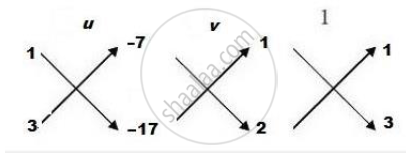
∴ `x/([1 xx (-1) - (-5) xx (-1)]) = y/([(-5) xx 1 - (-1) xx 1]) = 1/([1 xx (-1)-1 xx 1])`
⇒ `x/((-1 - 5)) = y/((-5 + 1)) = 1/((-1 - 1))`
⇒ `x/(-6)= v/(-4) = 1/(-2)`
⇒ `x = (-6)/(-2) = 3, y = (-4)/(-2) = 2`
Hence, x = 3 and y = 2 is the required solution.
