Advertisements
Advertisements
Question
Solve the following problem :
Minimize Z = 4x + 2y Subject to 3x + y ≥ 27, x + y ≥ 21, x ≥ 0, y ≥ 0
Advertisements
Solution
To find the graphical solution, construct the table as follows:
| Inequation | equation | Double intercept form | Points (x1, x2) | Points (x1, x2) |
| 3x + y ≥ 27 | 3x + y = 27 | `x/(9) + y/(27)` = 1 | A (9, 0) B (0, 27) |
3(0) + 0 ≥ 27 |
| x + y ≥ 21 | x + y = 21 | `x/(21) + y/(21)` = 1 | C (21, 0) D (0, 21) |
(0) + 0 ≥ 21 ∴ 0 ≥ 21 ∴ non-origin-side |
| x ≥ 0 | x = 0 | – | R.H.S. of Y-axis | |
| y ≥ 0 | y = 0 | above X-axis |
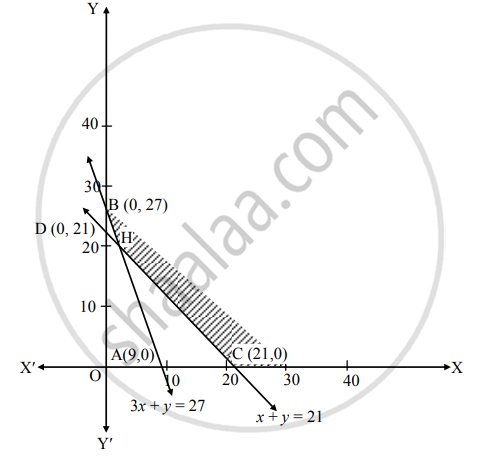
The shaded portion CHB is the feasible region.
Whose vertices are C(21, 0), H and B(0, 27)
H is the point of intersection of lines
3x + y = 27 …(i)
x + y = 21 …(ii)
∴ By (i) – (ii), we get
3 x + y = 27
x + y = 21
– – –
2x = 6
∴ x = `(6)/(2)` = 3
Substituting x = 3 in (ii), we get
3 + y = 21
∴ y = 18
∴ H (3, 18)
Here, the objective function is Z = 4x + 2y
Now, we will find minimum value of Z as follows:
| Feasible points | The value of Z = 4x + 2y |
| C (21, 0) | Z = 4(21) + 2(0) = 84 |
| H (3, 18) | Z = 4(3) + 2(18) = 12 + 36 = 48 |
| B (0, 27) | Z = 4(0) + 2(27) = 54 |
∴ Z has minimum value 48 at H (3, 18)
∴ Z is minimum, when x = 3, y = 18
APPEARS IN
RELATED QUESTIONS
A firm manufactures 3 products A, B and C. The profits are Rs 3, Rs 2 and Rs 4 respectively. The firm has 2 machines and below is the required processing time in minutes for each machine on each product :
| Machine | Products | ||
| A | B | C | |
| M1 M2 |
4 | 3 | 5 |
| 2 | 2 | 4 | |
Machines M1 and M2 have 2000 and 2500 machine minutes respectively. The firm must manufacture 100 A's, 200 B's and 50 C's but not more than 150 A's. Set up a LPP to maximize the profit.
A farmer has a 100 acre farm. He can sell the tomatoes, lettuce, or radishes he can raise. The price he can obtain is Rs 1 per kilogram for tomatoes, Rs 0.75 a head for lettuce and Rs 2 per kilogram for radishes. The average yield per acre is 2000 kgs for radishes, 3000 heads of lettuce and 1000 kilograms of radishes. Fertilizer is available at Rs 0.50 per kg and the amount required per acre is 100 kgs each for tomatoes and lettuce and 50 kilograms for radishes. Labour required for sowing, cultivating and harvesting per acre is 5 man-days for tomatoes and radishes and 6 man-days for lettuce. A total of 400 man-days of labour are available at Rs 20 per man-day. Formulate this problem as a LPP to maximize the farmer's total profit.
Solve the following L.P.P. by graphical method:
Minimize: Z = 6x + 2y subject to x + 2y ≥ 3, x + 4y ≥ 4, 3x + y ≥ 3, x ≥ 0, y ≥ 0.
Choose the correct alternative :
The point at which the maximum value of z = x + y subject to the constraints x + 2y ≤ 70, 2x + y ≤ 95, x ≥ 0, y ≥ 0 is
Fill in the blank :
Graphical solution set of the in equations x ≥ 0, y ≥ 0 is in _______ quadrant
Fill in the blank :
The region represented by the in equations x ≤ 0, y ≤ 0 lines in _______ quadrants.
State whether the following is True or False :
The region represented by the inqualities x ≤ 0, y ≤ 0 lies in first quadrant.
Solve the following problem :
Minimize Z = 2x + 3y Subject to x – y ≤ 1, x + y ≥ 3, x ≥ 0, y ≥ 0
A carpenter makes chairs and tables, profits are ₹ 140 per chair and ₹ 210 per table. Both products are processed on three machines, Assembling, Finishing and Polishing. The time required for each product in hours and the availability of each machine is given by the following table.
| Product/Machines | Chair (x) |
Table (y) |
Available time (hours) |
| Assembling | 3 | 3 | 36 |
| Finishing | 5 | 2 | 50 |
| Polishing | 2 | 6 | 60 |
Formulate and solve the following Linear programming problems using graphical method.
Solve the following problem :
A factory produced two types of chemicals A and B The following table gives the units of ingredients P & Q (per kg) of Chemicals A and B as well as minimum requirements of P and Q and also cost per kg. of chemicals A and B.
| Ingredients per kg. /Chemical Units | A (x) |
B (y) |
Minimum requirements in |
| P | 1 | 2 | 80 |
| Q | 3 | 1 | 75 |
| Cost (in ₹) | 4 | 6 |
Find the number of units of chemicals A and B should be produced so as to minimize the cost.
Solve the following problem :
A Company produces mixers and processors Profit on selling one mixer and one food processor is ₹ 2000 and ₹ 3000 respectively. Both the products are processed through three machines A, B, C The time required in hours by each product and total time available in hours per week on each machine are as follows:
| Machine/Product | Mixer per unit | Food processor per unit | Available time |
| A | 3 | 3 | 36 |
| B | 5 | 2 | 50 |
| C | 2 | 6 | 60 |
How many mixers and food processors should be produced to maximize the profit?
Solve the following problem :
A firm manufacturing two types of electrical items A and B, can make a profit of ₹ 20 per unit of A and ₹ 30 per unit of B. Both A and B make use of two essential components, a motor and a transformer. Each unit of A requires 3 motors and 2 transformers and each unit of B requires 2 motors and 4 transformers. The total supply of components per month is restricted to 210 motors and 300 transformers. How many units of A and B should be manufacture per month to maximize profit? How much is the maximum profit?
Choose the correct alternative:
The corner points of feasible region for the inequations, x + y ≤ 5, x + 2y ≤ 6, x ≥ 0, y ≥ 0 are
Choose the correct alternative:
The corner points of the feasible region are (0, 3), (3, 0), (8, 0), `(12/5, 38/5)` and (0, 10), then the point of maximum Z = 6x + 4y = 48 is at
Choose the correct alternative:
The corner points of the feasible region are (4, 2), (5, 0), (4, 1) and (6, 0), then the point of minimum Z = 3.5x + 2y = 16 is at
State whether the following statement is True or False:
If the corner points of the feasible region are `(0, 7/3)`, (2, 1), (3, 0) and (0, 0), then the maximum value of Z = 4x + 5y is 12
State whether the following statement is True or False:
If the corner points of the feasible region are (0, 10), (2, 2) and (4, 0), then the minimum value of Z = 3x + 2y is at (4, 0)
State whether the following statement is True or False:
Corner point method is most suitable method for solving the LPP graphically
State whether the following statement is True or False:
The point (6, 4) does not belong to the feasible region bounded by 8x + 5y ≤ 60, 4x + 5y ≤ 40, 0 ≤ x, y
State whether the following statement is True or False:
The graphical solution set of the inequations 0 ≤ y, x ≥ 0 lies in second quadrant
A set of values of variables satisfying all the constraints of LPP is known as ______
A company manufactures 2 types of goods P and Q that requires copper and brass. Each unit of type P requires 2 grams of brass and 1 gram of copper while one unit of type Q requires 1 gram of brass and 2 grams of copper. The company has only 90 grams of brass and 80 grams of copper. Each unit of types P and Q brings profit of ₹ 400 and ₹ 500 respectively. Find the number of units of each type the company should produce to maximize its profit
A chemist has a compound to be made using 3 basic elements X, Y, Z so that it has at least 10 litres of X, 12 litres of Y and 20 litres of Z. He makes this compound by mixing two compounds (I) and (II). Each unit compound (I) had 4 litres of X, 3 litres of Y. Each unit compound (II) had 1 litre of X, 2 litres of Y and 4 litres of Z. The unit costs of compounds (I) and (II) are ₹ 400 and ₹ 600 respectively. Find the number of units of each compound to be produced so as to minimize the cost
Maximize Z = 5x + 10y subject to constraints
x + 2y ≤ 10, 3x + y ≤ 12, x ≥ 0, y ≥ 0
Solve the following LPP graphically:
Maximize Z = 9x + 13y subject to constraints
2x + 3y ≤ 18, 2x + y ≤ 10, x ≥ 0, y ≥ 0
Solution: Convert the constraints into equations and find the intercept made by each one of it.
| Inequation | Equation | X intercept | Y intercept | Region |
| 2x + 3y ≤ 18 | 2x + 3y = 18 | (9, 0) | (0, ___) | Towards origin |
| 2x + y ≤ 10 | 2x + y = 10 | ( ___, 0) | (0, 10) | Towards origin |
| x ≥ 0, y ≥ 0 | x = 0, y = 0 | X axis | Y axis | ______ |
The feasible region is OAPC, where O(0, 0), A(0, 6),
P( ___, ___ ), C(5, 0)
The optimal solution is in the following table:
| Point | Coordinates | Z = 9x + 13y | Values | Remark |
| O | (0, 0) | 9(0) + 13(0) | 0 | |
| A | (0, 6) | 9(0) + 13(6) | ______ | |
| P | ( ___,___ ) | 9( ___ ) + 13( ___ ) | ______ | ______ |
| C | (5, 0) | 9(5) + 13(0) | ______ |
∴ Z is maximum at __( ___, ___ ) with the value ___.
If z = 200x + 500y .....(i)
Subject to the constraints:
x + 2y ≥ 10 .......(ii)
3x + 4y ≤ 24 ......(iii)
x, 0, y ≥ 0 ......(iv)
At which point minimum value of Z is attained.
