Advertisements
Advertisements
Question
Solve the following problem.
A metro train runs from station A to B to C. It takes 4 minutes in travelling from station A to station B. The train halts at station B for 20 s. Then it starts at station B and reaches station C in next 3 minutes. At the start, the train accelerates for 10 sec to reach a constant speed of 72 km/hr. The train moving at the constant speed is brought to rest in 10 sec. At the next station.
(i) Plot the velocity- time graph for the train travelling from station A to B to C.
(ii) Calculate the distance between the stations A, B and C.
Advertisements
Solution
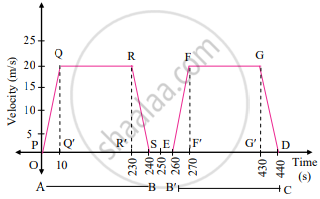
The metro train travels from station A to station B in 4 minutes = 240 s.
The trains halts at station B for 20 s.
The train travels from station B' to station C in 3 minutes = 180 s.
∴ Total time taken by the metro train in travelling from station A to B to C
= 240 + 20 + 180 = 440 s.
At the start, the train accelerates for 10 seconds to reach a constant speed of 72 km/hr = 20 m/s.
The train moving is brought to rest in 10s at the next station.
The velocity-time graph for the train travelling from station A to B to C is as follows:
Distance travelled by the train from station A to station B
= Area of PQRS
= A(Δ PQQ') + A(`square` Q'QRR') + A(SRR')
`= (1/2 xx 10xx20) + (220 xx 20) + (1/2 xx 10 xx 20)`
= 100 + 4400 + 100
= 4600 m
= 4.6 km
∴ Distance travelled by the train from station B' to station C
= Area of EFGD
= A(ΔEFF') + A(`square` F'FGG') + A(Δ DGG')
`= (1/2 xx 10 xx 20) xx (160 xx 20) + (1/2 xx 10 xx 20)`
= 100 + 3200 + 100
= 3400 m
= 3.4 km
APPEARS IN
RELATED QUESTIONS
Answer the following question.
Define average velocity and instantaneous velocity. When are they same?
Define the following term:
Free fall
Answer the following question.
If the motion of an object is described by x = f(t), write formulae for instantaneous velocity and acceleration.
Answer the following question.
Derive equations of motion graphically for a particle having uniform acceleration, moving along a straight line.
Solve the following problem.
An aeroplane has a run of 500 m to take off from the runway. It starts from rest and moves with constant acceleration to cover the runway in 30 sec. What is the velocity of the aeroplane at the take-off?
Solve the following problem.
A car moving along a straight road with a speed of 120 km/hr, is brought to rest by applying brakes. The car covers a distance of 100 m before it stops. Calculate
(i) the average retardation of the car
(ii) time taken by the car to come to rest.
Solve the following problem.
A car travels at a speed of 50 km/hr for 30 minutes, at 30 km/hr for next 15 minutes and then 70 km/hr for next 45 minutes. What is the average speed of the car?
Solve the following problem.
A velocity-time graph is shown in the adjoining figure.

Determine:
- the initial speed of the car
- the maximum speed attained by the car
- part of the graph showing zero acceleration
- part of the graph showing constant retardation
- distance travelled by car in the first 6 sec.
What is rectilinear motion?
Rectilinear motion is considered one of the simplest forms of motion because ______.
It's simple because the object moves in just one direction, not changing paths, ______.
In physics, along which axis is rectilinear motion typically studied?
A stone is thrown upward with a speed ‘u’ from the top of a tower reaches the ground with velocity ‘3u’. The height of the tower is: (g = acceleration due to gravity)
