English

Solve the Differential Equation `X Dybydx + Y = X Cos X + Sin X`, Given that Y = 1 When `X = Pi by 2 - Mathematics

Advertisements
Advertisements

Question

Solve the differential equation `x dy/dx + y = x cos x + sin x`,  given that y = 1 when `x = pi/2`

Advertisements

Solution

The given differential equation is

`x dy/dx + y = x cos x + sin x`

`=> dy/dx + y/x = (x cos x + sin x)/x`

This is a linear differential equation of the form `dy/dx + Py = Q`
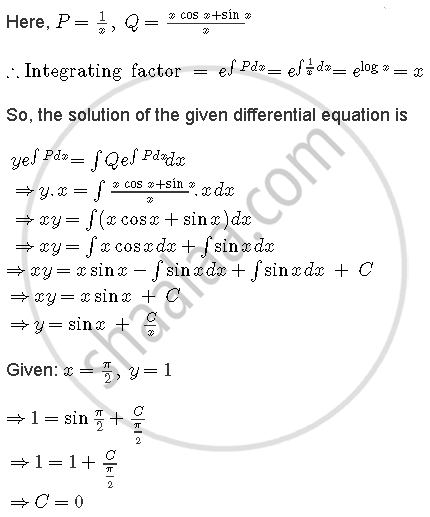
Thus, the particular solution of the given differential equation is sinx.

shaalaa.com
  Is there an error in this question or solution?
2016-2017 (March) Delhi Set 1

RELATED QUESTIONS

For the differential equation, find the general solution:

`dy/dx  + 2y = sin x`


For the differential equation, find the general solution:

`dy/dx + (sec x) y = tan x (0 <= x < pi/2)`


For the differential equation, find the general solution:

`cos^2 x dy/dx + y = tan x(0 <= x < pi/2)`


For the differential equation, find the general solution:

`(x + y) dy/dx = 1`


For the differential equation, find the general solution:

y dx + (x – y2) dy = 0


x dy = (2y + 2x4 + x2) dx


\[\left( 2x - 10 y^3 \right)\frac{dy}{dx} + y = 0\]

\[\left( \sin x \right)\frac{dy}{dx} + y \cos x = 2 \sin^2 x \cos x\]

Find the integerating factor of the differential equation `x(dy)/(dx) - 2y = 2x^2`


Solve the differential equation: (1 +x) dy + 2xy dx = cot x dx 


Solve the following differential equation:

`dy/dx + y/x = x^3 - 3`


Solve the following differential equation:

`"dy"/"dx" + "y" * sec "x" = tan "x"`


Find the equation of the curve passing through the point `(3/sqrt2, sqrt2)` having a slope of the tangent to the curve at any point (x, y) is -`"4x"/"9y"`.


The integrating factor of `(dy)/(dx) + y` = e–x is ______.


The integrating factor of the differential equation (1 + x2)dt = (tan-1 x - t)dx is ______.


The solution of `(1 + x^2) ("d"y)/("d"x) + 2xy - 4x^2` = 0 is ______.


The integrating factor of differential equation `(1 - y)^2  (dx)/(dy) + yx = ay(-1 < y < 1)`


State whether the following statement is true or false.

The integrating factor of the differential equation `(dy)/(dx) + y/x` = x3 is – x.


If y = y(x) is the solution of the differential equation, `(dy)/(dx) + 2ytanx = sinx, y(π/3)` = 0, then the maximum value of the function y (x) over R is equal to ______.


Let y = f(x) be a real-valued differentiable function on R (the set of all real numbers) such that f(1) = 1. If f(x) satisfies xf'(x) = x2 + f(x) – 2, then the area bounded by f(x) with x-axis between ordinates x = 0 and x = 3 is equal to ______.


Let y = y(x) be the solution curve of the differential equation `(dy)/(dx) + ((2x^2 + 11x + 13)/(x^3 + 6x^2 + 11x + 6)) y = ((x + 3))/(x + 1), x > - 1`, which passes through the point (0, 1). Then y(1) is equal to ______.


Let the solution curve y = y(x) of the differential equation (4 + x2) dy – 2x (x2 + 3y + 4) dx = 0 pass through the origin. Then y (2) is equal to ______.


If the solution curve y = y(x) of the differential equation y2dx + (x2 – xy + y2)dy = 0, which passes through the point (1, 1) and intersects the line y = `sqrt(3)  x` at the point `(α, sqrt(3) α)`, then value of `log_e (sqrt(3)α)` is equal to ______.


If sin x is the integrating factor (IF) of the linear differential equation `dy/dx + Py` = Q then P is ______.


The solution of the differential equation `dx/dt = (xlogx)/t` is ______.


The slope of the tangent to the curve x = sin θ and y = cos 2θ at θ = `π/6` is ______.


Share
Notifications

Englishहिंदीमराठी


      Forgot password?
Use app×